Showing posts with label panic. Show all posts

Monday, 1 January 2024

Six zombie ideas in crowd psychology


What are zombie ideas? These are ideas that keep coming back, even though they have been thoroughly refuted by the evidence. They should be dead, but they won’t stay dead! They keep coming back because they serve certain interests or prejudices (or both). Here are six zombie ideas in crowd psychology that keep cropping up in everyday talk, in the news, among policymakers and practitioners, and in academic publications. And here’s why they’re wrong.

1. De-individuation

The most distinctive claim in the ‘de-individuation’ family of theories was inherited from Gustave Le Bon – the idea that being anonymous leads to a loss of self and hence uncontrolled, anti-normative behaviour. This idea could not cope with the evidence that conditions of anonymity in fact are associated with a wide range of behaviours, including accentuation of pro-social behaviours. There is little evidence that anonymity leads to a ‘de-individuated’ state of reduced private self-awareness. Rather, anonymity makes group identities more salient and hence leads to more, not less, conformity to relevant situational norms.

Key reading: Postmes & Spears (1998)


Gustave Le Bon headstone
(Pierre-Yves Beaudouin / Wikimedia Commons / CC BY-SA 4.0)

2. Groupthink

While groupthink is supposedly a pitfall of small groups and organizations rather than crowds, I include it here as it’s another example of an anti-collectivist concept. It is used loosely by commentators to refer to any situation where group members prioritise the group’s own ideas over critical or external views. For example, some of those involved in decision-making at the height of the Covid pandemic have used the idea of groupthink to explain organizational failures in decision-making. The distinctive claim of the ‘groupthink’ concept is that highly cohesive groups will be subject to concurrence-seeking at the expense of critical inquiry, leading to faulty decisions. A big problem for this idea is that there is not much evidence that greater cohesiveness leads to worse decision-making. Rather than the tendency to ignore critical evidence being a function of groupness, it’s more likely to be an effect of particular group norms (for example that value loyalty).

Key reading: Aldag (2022)

3. Mass panic

Aside from the profound problems of judging whether behaviour counts as ‘panic’ in an emergency (what is reasonable behaviour in this situation?) and the related problem of trying to import a polysemic everyday term into scientific explanation, there is another basic problem. There is no evidence that people in crowds are typically uncontrolled, selfish or competitive in emergencies. The common finding of social support among people in emergencies adds to the problems of this concept.

Key reading: Clarke (2002)

4. Contagion

One of the most popular concepts in the social and behavioural sciences, ‘contagion’ is often used synonymously with spread and social influence. But there is little evidence that mere exposure alone is sufficient to prompt emulation. Group boundaries in the transmission of behaviours and emotions demonstrate this. Even for supposedly basic processes like so-called emotional contagion, reviews of the evidence suggest that the mimicry involved is not automatic, but rather relates to communication goals that already involve an emotional orientation to the other person.

Key reading: Drury et al. (2019)

5. The hooligan

The hooligan is a concept from sociology more than psychology, but it is a good example of a dispositional explanation. For the earliest beginnings of crowd psychology as a science, some have claimed that crowd conflict occurs through the convergence of certain kinds of individuals (usually with criminal, violent, or poorly socialized dispositions). From the 1960s urban riots in the USA to the 2011 English riots, proponents of such ideas have failed to produce the required evidence. In the football context, of course some groups seek conflict, but this in itself can’t explain collective behaviour. As Stott and Pearson explain, the 'hooligan' concept has little explanatory power: ‘disorder’ sometimes occurs when known ‘hooligans’ are not present; and when known ‘hooligans’ are present, ‘disorder’ doesn’t always take place.

Key reading: Pearson & Stott (2022)

6. Mob mentality

An overarching zombie idea, that links many of the above, but which also includes the distinctive claims that in crowds people revert to a simpler, less intelligent, and more primitive or archaic psychology, under the influence of which behaviour tends to gullibility, barbarism, loss of control, and violence. The fundamental problem here is two-fold. First, if this is a real tendency it cannot easily explain the majority of crowds, which are peaceful and pro-social. Second, the suggestion of a universal tendency like this cannot explain the social form of behaviour when there is crowd violence. To explain the distinct targets of the sans culottes, urban rioters, football fans and many others, and the sophistication in even the most violent crowd, it makes better sense to refer to their identities, group norms, and values.

Key reading: Reicher (1984)

Thursday, 1 September 2016

In disasters like the Great Fire of London, ordinary people are the best emergency service

http://www.telegraph.co.uk/news/2016/09/01/in-disasters-like-the-great-fire-of-london-ordinary-people-are-t/

Monday, 29 June 2015

The psychology of bank runs

The announcement today that Greek banks will be closed at least until the referendum on Sunday was apparently prompted by the decision of the European Central Bank (ECB) to end the financial support that has allowed the banks to function despite people withdrawing their money for months. The behaviour of the public in withdrawing their money has been described as a ‘bank run’ and, in some places, a mass panic. Based on our research and the wider literature on so-called ‘panics’ in crowds, three simple points can be made about the current Greek bank run.

1. It is misleading to describe the behaviour of people withdrawing their money as ‘mass panic’. In ordinary conversation, the term ‘panic’ is used to talk about, and to do, different things (such as blaming, excusing and so on); but one consistent association is that of the abandonment of social rules through undue haste. Yet the crowds depicted queuing at Greek ATMs, like those observed by sociologists studying bank runs, have been cooperative and orderly. Another association of the term ‘panic’ is extreme or sudden emotion. But, as is often the case in bank runs, the people queuing were also relatively calm. This suggests that emotion is not the defining issue in bank runs at all.

2. Participating in a bank run, particularly when it’s already begun, is often a reasonable course of action for the individuals concerned. Another implication of the term ‘panic’ is that such behaviour is self-defeating and irrational. In his study of the Home State Savings Bank Run in Cincinnati in 1985, Johnson pointed out that, when everybody else is taking their money out, the real risk is not to oneself but rather being last in the queue and the money runs out. All the individual withdrawals may lead to the collapse of the bank, and so have damaging consequences for the wider collective (including those who have yet to take their money out); yet appeals for people to be patient or to trust the bank would only be heeded where they perceive others (including those other banks and businesses withdrawing funds) to be patient and trusting.

3. Reassurances and other communicative acts may inadvertently create and sustain a bank run. In their study of the 2007 Northern Rock bank run, Gillespie and Cornish note that when the Bank of England gave Northern Rock an emergency loan, this was widely seen as a signal of the bank’s imminent demise. The BBC reported that ‘Treasury Select Committee chairman John McFall urged Northern Rock customers not to panic’. Yet, in a situation where trust was diminishing, such reassurances are likely to have backfire effects – which was precisely the case for Northern Rock.


A last point is that one reason that bank runs are described as panics is because the run is apparently based on a false belief or rumour. From the outside, and with access to all the relevant information, the commentator might be able to judge that the rumours were false – for example that the bank is not really in trouble (yet) and that there is no need (yet) to withdraw funds. But in the current context, when bankers and their allies in government have repeatedly lied and have constructed complex arrangements for their own profits around a series of financial fictions, who’s to say that the rumour among the public about the trustworthiness of the bank is an unreasonable belief? Who should people trust?

Arabic version:
https://blogs.sussex.ac.uk/crowdsidentities/2015/06/30/the-psychology-of-bank-runs-arabic-version/

Greek version:
https://blogs.sussex.ac.uk/crowdsidentities/2015/07/03/psychology-of-bank-runs-greek-version/

Friday, 10 October 2014

Ebola and the usefulness of ‘panic’

When there is an emergency in the news, I am often asked by journalists to comment on how people behave in such circumstances. The main question is usually ‘why do people panic?’ A follow up question is typically along the lines of what governments can do to stop people panicking. I was asked this about the Ebola crisis only today.

My interest in these kinds of questions developed from an ESRC-funded project in which I and colleagues developed a social identity explanation of crowd behaviour in emergencies. According to this explanation, under certain conditions, an emergency can create a shared social identity amongst survivors which is the basis of inclusive solidarity behaviours amongst them. In line with previous work in sociology and psychology, the research from this project questioned the usefulness of ‘panic’ as a description of mass emergency behaviour, both empirically and conceptually.

Empirically, instances of crowd solidarity in emergencies were too common for the crowd to be an inherent conduit of unreasonable fears and personally selfish behaviours, as the concept of ‘mass panic’ would imply. Where escape behaviour is disorderly and individualistic, it is not the crowd as such that is the psychological problem but the fact that people are acting as individuals when they are in a crowd.

Conceptually, even for those crowds where sudden fear spreads or where escape behaviours are frantic, what is the criteria for labelling such responses as ‘panic’? Reasonableness is often in the eye of the beholder – especially in emergencies where it is not clear to those involved just exactly how much danger they are in. Research on fires shows that its safer to ‘over-react’ than ‘under-react’.

Yet the same research that questioned the usefulness of crowd ‘panic’ as a thing also pointed to the importance of ‘panic’ as a representation. ‘Panic’ exists as a discourse or interpretative repertoire in popular culture and in organizations’ texts, and can be mobilized to achieve various goals. This was the basis of a second programme of research, funded by the Leverhulme Trust.

The Leverhulme research found that ‘panic’ was widespread as a representation, and that it could operate as the warrant for emergency measures such as limiting public information and maintaining expert control (‘the public can't be trusted – they will panic’). As well as being used by those preparing for emergencies, ‘panic’ is used by those caught up in such events. Survivors of the 1989 Hillsborough football disaster used the term ‘panic’ to excuse their own ‘uncharacteristic’ behaviour and to criticize the police approach during the event.

What was clear here and in other places was the considerable usefulness of the term ‘panic’ as a way of explaining ‘wrong’ behaviour and hence of making a criticism.

The usefulness of the discourse of ‘panic’ as a device in criticism is also evident in two concepts in sociology: moral panic and elite panic. Stanley Cohen’s concept of moral panic characterized a societal response of hostility and/or concern towards a group or social object that becomes seen as a moral threat. In his example of the moral panic over mods and rockers in the 1960s, Cohen was not simply describing this concern but arguing that it was overstated, unreasonable and exaggerated: it was a panic. Yet the process behind this panic was not one of collective pathology; the panic didn't arise because of collectivity but rather because of particular sets of interests, such as the media and other ‘elites’, which actively constructed the threat to channel existing public concerns.

The concept of elite panic, coined by Lee Clarke, was useful as a way of turning round the ‘crowd panic’ debate. He argued that it is not the public that panics in emergencies but the government when they start to see the grassroots self-organization in affected communities which effectively challenge the legitimacy and necessity of government control.

Elite panic is perhaps a concept that comes to mind when considering the Ebola crisis. The UK Government may not be alarmed by public self-organization right now, but it certainly appears to many to be acting in an ill-judged and hasty manner. Yesterday morning, the Government said that no screening measures were necessary at UK airports, in line with advice from the World Health Organization (WHO). But, by the afternoon, it was announced that people arriving in the UK from areas hit by Ebola would face ‘enhanced screening’ for the virus. Was this some kind of elite overreaction? The medical advice from WHO and others had not changed; and the chairman of the government's own Advisory Committee on Dangerous Pathogens, Professor George Griffin, was quoted as saying that the screening measures to be used - temperature tests - were ‘a very ineffectual tool’.

Comparing this to another recent ‘crisis’, there does seem to be considerable scope for criticism using the discourse of ‘panic’. In March 2012, when there was a threat of a fuel tanker driver strike and the possibility of petrol shortages, the prime minister David Cameron went on television especially in order to make an official announcement that there was no crisis. At the same time, the Cabinet Secretary Frances Maude advised drivers to stock up on petrol. This made strategic sense for a Conservative government which had an interest in apportioning blame to potential strikers - for that was one effect of Cameron and Maude’s ‘communications’. But what was rational for the Government was certainly ill-judged from the point of view of ‘society as a whole’, and this was the basis of much of the criticism. The very fact of making such a high profile official announcement was to communicate that there was something to be very concerned about, no matter what the content of Cameron’s speech. And in saying ‘don’t worry, but do prepare’, Maude in effect communicated to the public that there was indeed cause for worry - and thereby hastened queues at petrol stations based on these reasonable fears.

Likewise with Ebola. Critics have argued that the Government’s apparently hastily-introduced screening measure is not a serious attempt to stop the spread of the disease, but something implemented to look at though the Government is ‘doing something’: it is politically motivated. But while the measures may make political sense from the perspective of the Conservative government, which might not be concerned that they are actually ineffective, we can also criticise them for risking creating unnecessary public fear of a threat where there wasn’t one previously.

For these reasons, the term ‘panic’ can be useful as form of criticism of actions by Governments that have unintended damaging effects on others. And the stock answer to the journalists’ questions are these:
Question: ‘Why do people panic?’
Answer: People’s fears in crises may be reasonable given what they know of the threat, which might be mediated through their perceptions of Government preventative measures.
Question: ‘What can governments and others can do to stop people panicking?’ 
Answer: When there is little evidence of widespread public fears, high profile acts and announcements by Government to prevent a ‘crisis’ can produce that crisis – so avoid them. 

Wednesday, 28 March 2012

The logic of ‘panic buying’


This week, the government (and the mass media) have been criticized for promoting ‘panic-buying’ of petrol in the context of a possible tanker drivers strikeHere at Sussex University, we have been looking at the use of the word ‘panic’, and at the kinds of behaviours that are sometimes labelled in this way. We have also worked alongside emergency planners and crowd safety management professionals on this question of communication in possible emergency situations. Based on this work, there are three simple points to make about the current situation of supposed ‘panic-buying’.

Run on the Seamen's Savings' Bank during the so-called ‘panic’ of 1857 (courtesy of Wikipedia commons)


1, Don’t say ‘don’t panic’

The first point is that the advice ‘don’t panic’ is worse than useless. When those in authority say ‘don’t panic’, or even ‘stay calm’, the rest of us know by this that there is definitely something we should be anxious about – for why else would they be warning us in this way? And why else should they be so concerned about our emotional responses if not because they think there is something that we might ‘panic’ about? In the present case, the advice that there was no crisis, but that people should fill up their cars just in case, was as good as advice to act exactly as though a crisis was imminent and therefore to fill up as much as we can.

2, Belief that there is ‘panic’ makes it logical to act individualistically

The advice ‘don’t panic’ is based on the mistrust by the government of the (potentially irrational) ‘masses’. In turn it sows mistrust. It does this in two ways. First, the advice communicates that the government is holding something (scary) back from the public, so creates mistrust between public and government. Second, reference to ‘panic’ risks creating mistrust amongst members of the public themselves. When the government and the mass media tell us that our neighbours are ‘panic-buying’, we imagine those around us acting individualistically, rushing to hoard goods for themselves. And if we imagine that everyone else is acting this way, it becomes foolishly self-sacrificial to do otherwise oneself. Rather, it becomes completely logical to look after number one. The result is that we trust our neighbours less to act patiently and in the collective interest.

3, ‘Panic buying’ is not panic

The third point is that the large queues and the rush to stock up does not really fit the criteria for panic. Journalists reporting from the scene of petrol queues note with surprise the calm, boredom and stoicism of the people waiting in line. ‘Panic’ is a clinical condition marked by an excessive fear and anxiety reaction, the physiological signs of which include raised heart rate, shortened breath, sweating and so on. This excessive anxiety prompts reckless, uncontrolled behaviour. People queuing for petrol in so-called ‘panic buying’ may be acting in their personal interest rather than the collective interest, but this is cognitively driven rather than an instinctive ‘flight or fight’ response. The queuing and bulk-buying  is logical - given people's reasonable beliefs about others’ behaviour and their reasonable mistrust of the authorities.  And there is no spread of irrational beliefs or emotions through these crowds. As I have argued elsewhere, there is no evidence to support the argument that crowds are susceptible to the uncritical spread of simple emotions through so-called ‘contagion:‘mass panic’ is a myth

It is often the mass media, more than the politicians, who mobilize the ‘panic’ cliché to describe consumer queuing and stock piling. It is perhaps encouraging to report, therefore, that not all journalists are so lazy. After an interview we gave on Radio Leicester to discuss our ESRC research project on mass emergency behaviour, the reporters were so convinced by the argument that they made it a policy not to use the term in future.

However, we don’t think that solutions to the problems produced by mutual mistrust and individualism lie only or essentially in changing the messages given out by those in authority. It was notable that, in his nervous back-tracking, David Cameron referred to ‘resilience’ as just a quality of the state and its functionaries. We have been exploring the informal resilience of crowds, which expresses itself in solidarity and is a function of shared social identity among crowd membersWe are currently running some experiments to show that, when people think of themselves in terms of their social identities (e.g., ‘me as a member of my community’) they will be more cooperative, less ready to push in to queues, and more willing to share dwindling supplies with strangers than when they think of themselves in terms of their personal identities (e.g., ‘me as distinct from others in my community’). If the outcomes of the behaviours labelled as 'panic-buying' are dysfunctional for the collective (e.g., more acute shortages for most as the minority hoard goods) it is precisely because people in the crowd are acting reasonably as individuals,  rather than as members of a psychologically united crowd; cf. Mintz, 1951.)

References


Drury, J., Cocking, C., & Reicher, S. (2009). Everyone for themselves? A comparative study of crowd solidarity amongst emergency survivors.British Journal of Social Psychology, 48, 487-506. DOI:10.1348/014466608X357893

Drury, J., Cocking, C., & Reicher, S. (2009). The nature of collective resilience: Survivor reactions to the 2005 London bombingsInternational Journal of Mass Emergencies and Disasters, 27, 66-95.


Mintz, A. (1951). Non-adaptive group behavior. Journal of Abnormal and Social Psychology, 46, 150-159.


Saturday, 10 September 2011

What do the events of 9-11 tell us?

From the beginning, the mass evacuations of September 11th 2001 were thought to tell us something important about the nature of collective responses to emergencies and disasters. In the months and years following the events, social scientists carried out detailed research investigations of behaviour during the evacuations. Some of their key findings were as follows:

- The building evacuations were highly successful; 99 per cent of occupants below the sites where the planes struck survived. The success was due in large part to efficient spontaneous mass coordination among the people who moved down the stairs of the World Trade Centre towers.

 - Cooperation and helping behaviour was common among the building evacuees

 - Panic was not a collective response; Ed Galea's team found that panic ‘was only noted in 1/124 (0.8%) cases’; gathering information was a more common response to the emergency.

 - Over one million people evacuated themselves from the area of New York affected by the disaster, and thousands of members of the public converged on the city in order to offer help to the survivors. A strong sense of community arose among those involved in the evacuation and in the relief effort.

What do these kind of findings mean for our understanding of the nature of collective responses to emergencies and disasters?

For researchers, this is further evidence against already discredited theories such as ‘mass panic’. Theories of ‘mass panic’ suggest that exaggerated fear responses to danger spread easily through a crowd in a process of ‘contagion’, leading to rash, uncoordinated and ultimately dysfunctional behavioural outcomes, such as fighting for and blocking exits. Against this, current thinking on group processes suggests that group membership is not a source of pathology but a source of strength. Psychological group membership provides expectations of unity, offers of support and hence the organization and collective agency people need to respond effectively to adversity. The evidence from the 9-11 evacuation is in line with this account of group processes.

However, the evidence of collective resilience during 9-11 has also been interpreted by some as telling us something about the national identity of the USA. In this account, the resilient behaviour of the evacuees stands for or represents the character of the rest of those included in the national category.

Are there cross-cultural differences in mass emergency behaviour?

On the one hand, and at least in one sense, it is surely right to say that the evidence from the 9-11 evacuations tells us something about American responses to adversity.

One (mis)reading of cross-cultural psychology gives rise to the question of whether people from individualist national cultures (like the USA) will display less solidarity in mass emergencies than those from ‘collectivist’ cultures (such as Japan). It is a question that I am often asked when I give research presentations. One answer to the question is that, across national cultures as diverse as Japan, the USA, Britain and Germany, the same pattern of solidarity (rather than mass panic) has been documented in response to mass emergencies and disasters. The evidence of mutual coordination and co-operation shown by ‘ordinary Americans’ in the 9-11 mass evacuations therefore undermines notions that this country’s individualist culture precludes the emergence of ties of solidarity and collective strength.

On the other hand, when the collective resilience witnessed in the 9-11 evacuations is taken by politicians and propagandists to demonstrate something special or exceptional about the psychology of the American national category, we can see problems. Specifically, there are two problems with this kind of claim.

Problem 1: Every national category is claimed by its leaders to be ‘special’ in times of war

The first problem is that representatives of every nation state try to claim that their citizens’ resilient response to adversity is special or even unique. It is no coincidence that highlighting public resilience and characterizing the resilient group as standing for the whole national category is particularly prominent in times of war.

In the second world war, the British state highlighted the ‘Blitz spirit’ of Londoners, who faced nightly bombing raids, as a way of raising national morale. The terminology and the image were less a neutral description of events than an attempt to mobilize and create national unity around the war. Following the London bombings of July 2005, politicians and commentators similarly evoked the ‘bulldog spirit’ of Londoners, attributing the calm orderly response of survivors to their special characteristics, which would again serve the nation well in a time of war 'against terror'.

As simple descriptions, these claims to exceptionalism are undermined by the same kind of review evidence that tells against the cross-cultural hypothesis. However, they are not simply descriptions. They are attempts to rally people to wars, and to bring about the resolve and unity of which they speak; they can also operate as exhortations to endure privations in the interest of war on behalf of the national category.

This takes us to the second problem.

Problem 2: Are we really ‘all in it together’?

The second problem with explaining events such as the 9-11 evacuations in terms of the qualities of the national category is that it glosses over possible differences among those included in 'the nation' in terms of interests, experiences and behaviours. Disaster psychologists tell us that both suffering and assistance are often distributed inequitably — reflecting structured inequality in resources (for example by class)

Disaster sociologists and critical journalists add that ‘elites’ and ‘masses’ perceive and respond to emergencies and disasters differently. This can mean that definitions of collective threat may not be universally shared, and therefore that solidarity may be bounded. Specifically, the representatives of the ‘elites’ may regard the response of the mass as more problematic than the emergency itself, and act against the mass on this basis. This is perhaps most starkly illustrated in examples such as Hurricane Katrina in 2005. In that ‘national emergency’, grassroots solidarity arose particularly in the black working class. However the authorities neglected and imperilled their safety, demonized and pathologized them in propaganda, and colluded in their racist murder.

Accounts of the evacuation of 9-11, by contrast, paint a far less fragmented picture, and indeed illustrate how different sections of society displayed camaraderie during the evacuation.

However, the narrative of businesses and workers alike coming together in shared humanity is somewhat problematized by the fact that, when the first plane struck on 9-11, the immediate response of the Port Agency, who are in charge of the World Trade Centre buildings, was to urge employees to return to their desks. Luckily, most people ignored this advice!

And in the aftermath, a number of underlying social conflicts became explicit. One of the fundamental tensions within the national category was between the masses and the professionals acting on behalf of the ‘elite’. Grassroots and unofficial groups and networks had established themselves and were managing very well to organize food, housing, communications and security for evacuees. But official organizations moved in and sought to shut them down. The ‘festival of mutual aid’ was superseded by an 'elite panic’.

It was not the ‘elite’ and their professionals who effected the mass evacuations; the masses achieved it themselves. The 911 emergency call system was ineffective; the police and fire service did not coordinate properly; people organized evacuation and relief despite, not because of, the normal hierarchical rules and relations. The collective response to the emergency was effective precisely because it was not centrally directed; but professionalization of, and exclusive control over, humanitarian relief was nevertheless imposed. The national policy response went further: national (‘homeland’) security, emphasizing suspicion of one’s neighbours and the need for further centralized control. Through its actions, the ‘elite’ undermined sources of collective resilience and hence produced the very vulnerability - including paralysing fear, lack of freedom and reduced agency - that it was premised upon.

What do the events of 9-11 tell us?

The 9-11 evacuations tell us at least three things.

First these events illustrate very vividly the human potential for solidarity within groups in conditions of adversity.

Second, collective psychosocial resources – and especially the informal and context-dependent psychological groups we belong to – may well be more important than expert and professional response in times of emergency. For one thing, in a large scale emergency, the emergency professionals will simply not be in place in sufficient numbers to be effective.

Third, while the ‘elite’ therefore relies on the masses in emergency response, it also fears them. The otherwise useful concept of ‘elite panic’ could be read as implying that this fear is simply irrational. Elite responses may well be ill-judged, but they may be grounded in fear of real potentials. Following Charles Fritz, Rebecca Solnit argues that disasters are microcosms of mutual aid that may provide insightful glimpses of social possibility. It may be that elites recognize these subversive qualities too, and hence the potential danger to their own privileged position. 

Reference

Drury, J. (2012). Collective resilience in mass emergencies and disasters: A social identity model. In J. Jetten, C. Haslam, & S. A. Haslam (Eds.), The social cure: Identity, health, and well-being (pp. 195-215). Hove, UK: Psychology Press.


Sunday, 23 January 2011

Why do ‘stampedes’ happen at crowd events?

On a regular basis, the mass media report tragedies at crowd events intended as positive, uplifting experiences for their participants. Recent examples include the deaths at the Cambodian Water festival  and the Love Parade in Duisberg, Germany. Very often, such reports describe mass casualties at religious pilgrimages – such as the recent tragedy in India.

There is a recognizable pattern to the reporting of these kinds of events. Inevitably, there is a ‘stampede’, which is caused by ‘panic’ in the crowd. These loaded terms form an off-the-shelf framework for not simply describing but also offering a ‘common sense’ explanation of such events.

‘Stampeding’ is the behaviour of herd animals. The word ‘stampede’ therefore conveys something different from the word ‘fleeing’. It implies that the behaviour is primitive, instinctive

‘Panic’ is a psychological state. It implies a rashness or irrationality in response to (perceived) danger, and hence a failure to consider or be constrained by one’s critical judgement or the usual social rules.

The clear implication in describing these fatal crushes as ‘stampedes’ brought on by ‘panic’ is that people are more likely to respond in these ways in crowds than they are alone. They are more credulous, more driven by simple emotions, more excitable, more impulsive, more barbaric. In crowds, apparently, we forget the social obligations that structure our normal interaction. Instead, acting as asocial individuals, we trample each other and even kill ourselves in our attempts to escape perceived danger.

In the accounts of tragedies at religious pilgrimages, there is an implicit or sometimes more explicit linkage of this mass psychology to the exoticism and religious beliefs of the victims. Whether or not it is intended, the news accounts can sometimes be read as explaining such stampedes as partly due to the nature of the particular groups involved: they are presented as especially credulous, excitable, and so on.

By contrast, the notion of the intellectually inferior crowd – whether due to the ‘group mind’ or ‘personality’ – is out of favour with psychologists. And the idea of ‘mass panic’ has been regarded as a ‘myth’ by sociologists for over 50 years.

Therefore, when crowd events end in tragedy, when the news reports a ‘stampede’ due to ‘panic’ in the crowd, I am often asked whether the social scientists haven’t got it wrong after all. Is there in fact something about events such as religious pilgrimages that marks them out as exceptions, i.e., as the types of events where ‘mass panic’ is more likely to occur? If not, how can we explain tragedy on such a scale?

One of the problems in giving a categorical answer to such questions is that the journalists’ accounts are often all we have to go on. Events are often described sketchily, the same source is often used across ‘different’ news accounts, and details and witnesses are not as extensive as we would like. The images of people walking over each other, falling off bridges and so on say little about the context of the single episode or what was going on in the mind of the person being depicted.

But usually even the most limited and cliché-ridden accounts contain snippets that problematize and undermine the ‘mass panic’ explanation.


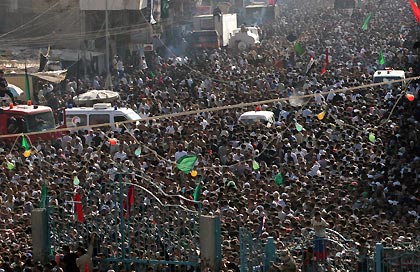
The death toll in the event was about 1000, with another 465 individuals injured. At first sight, news reports suggest that this event fits the pattern for ‘mass panic’:

1. sudden (exaggerated?) fear of a suicide bomber, spreading (like 'contagion') through the crowd.
2. limited exit due to the large numbers and lack of space.

These are indeed the classic conditions for ‘mass panic’ to occur.

Some of the behaviours cited also chime with the ‘panic’ explanation:

1. the vulnerable (elderly, women etc.) being crushed,
2. people all pushing each other,
3. apparently desperate suicidal-sounding acts of escape (jumping off the bridge), and
4. the usual reference to a 'stampede' (‘directionless’, instinctual fleeing)

Yet there are a number of other features in these same news accounts which muddy this simple picture:

1. The BBC Middle East analyst Roger Hardy is quoted as saying that, because of ongoing radical Sunni attacks on big Shia gatherings, it was 'not unreasonable' for the worshippers to be 'nervous'. This undermines a little the notion of the pilgrims' fear of a suicide bomber being irrational or exaggerated.
2. There were many attempts to help. In fact, someone is described in a couple of media sources as dying in his attempts to rescue people from the river. This turns around the process in the ‘panic’ account where deaths occurs because of ‘self-preservation’.
3. Some said that they were physically unable to help others because of the crush: "They were crying, shouting out 'please rescue me', but there was no way to help them," said Hadi Shakir, 25, a street trader. (Guardian).
4. Some people said they dived into the river to save themselves (by swimming) ; others fell in due to the crush (rather than dived).
5. In the aftermath, there were statements blaming the authorities for the lack of guidance given to the pilgrims in relation to the levels of density. Put differently, the crush itself might be understood as something which is much more an issue of crowd management than crowd psychology.

It can be argued that what happens to people on becoming part of a large crowd is not loss of control but loss of view. Within a large, dense crowd, one often cannot see how much congestion there is at the head of the crowd, whether people up ahead have stopped, or whether one is walking into a blind alley. The authorities and those overseeing the event have this kind of overview, however - and with it the responsibility to communicate with and marshal the crowd appropriately. From the little information that was put out regarding the official report into the Baghdad event, it seems possible to conclude that the tragedy was preventable had it been managed differently.

This is not to deny that some isolated individuals in the Baghdad crowd may have panicked, or that some may have acted selfishly, or that many were frightened. Nor is it to deny that in some crowd events people display more individualism (personal selfishness) than in others, and that this can contribute to a tragic outcome. To know whether a physical crowd event is also a psychological crowd event, we have to know the extent to which behaviours are socially shared and socially sanctioned. Not just any thought or emotion spreads through a crowd.

Nor is this to deny the importance of the ‘physics’ of crowd events, both as a dynamic force and as a constraint. Sometimes sheer physical pressure pulls people along, and what may appear as intentional or motivated is not. And sometimes people want to coordinate and to help others, but they are physically prevented.

We gain little and lose a lot by use of the terms ‘mass panic’ and ‘stampede’ to describe mass fleeing behaviour. They obscure more than they reveal about collective psychology in stressful events. It is not a coincidence that they are regularly wheeled out as explanations for tragedies by those who might be blamed for the events – the negligent event organizers and safety managers. To locate the cause of the tragedy in the inherent foolishness and selfishness of the crowd is to absolve oneself of responsibility.

A long-term aim in our research group is to look at how extremely large mass events such as religious pilgrimages go right and how they go wrong. Methodologically this means taking seriously the accounts of pilgrims themselves, rather than studying just their observable behaviour and trying to infer from that their perceptions, beliefs and emotions. It also means looking at how those managing the crowd act and think. What are their beliefs about crowd psychology, for example. How do these impact upon their management practices and, in turn, on the experience of those they manage?

References.


Drury. J., & Reicher, S. (2010). Crowd control. Scientific American Mind, November/December 2010, 58-65.

Drury, J., Cocking, C., & Reicher, S. (2009). Everyone for themselves? A comparative study of crowd solidarity amongst emergency survivors. British Journal of Social Psychology,  48, 487-506. DOI:10.1348/014466608X357893