Showing posts with label protest. Show all posts

Thursday, 11 June 2020

After George Floyd: Why does civil unrest spread between cities?

Protests and riots that began in Minneapolis after police killed an unarmed African American have now spread to over 23 states. I recently led a large-scale programme of research on the wave of riots in England in 2011 to address the question of how such events spread. The UK and US waves were different in important ways – most obviously, in the US many of the collective events have been peaceful protests, whereas in England only the initial protest was peaceful. Yet there are some striking similarities between them, as well as with other waves of riots. This similarity suggests that some of the same processes are operating.

It's necessary to begin by examining the meaning of the precipitating incident and the social categories involved. What did ‘they’ do, and who are ‘we’?

In Minneapolis 2020, as in Tottenham in 2011 (and as in Watts 1965, Brixton 1981 and many others), actions by police officers against an individual encapsulated the whole relationship between a wider group and an institution. In each case, the violence inflicted was seen as embodying the history of relations between police and Black / African-American people, where police harassment, assault, and collective humiliation were a daily experience.

Our research found that a local history of police harassment was key predictor of which districts rioted in London in 2011. Other predictors were local deprivation and negative attitudes to the police. Research in the US has found that race is another predictor of where riots occur. These factors correlate, of course: African-Americans are more likely to live in deprived districts and to be subject to police harassment and killing.

But these factors are relatively constant. They help explain which cities riot, but they don’t tell us when and how protest or rioting in one city influences people in other cities to join a wave. 

We found three types of social-psychological processes that helped explain how a wave occurs. 

First, there is spread via a shared identity with those in other cities. This is where people in different locations each define themselves in terms of a similar shared history of injustice at racist policing and resistance to that injustice. Our interviewees said of the police killing of Mark Duggan in 2011, ‘that could have been me’ and ‘that could have been my friends’. This shared identity with those rioting in response to the killing provided a normative motivation to do the same in their own district: the police needed to be shown that they cannot get away with murder. In the case of the George Floyd events, African American identity, defined in terms of a history of police violence, is clearly a key factor leading people in many cities to feel the same sense of injustice and anger as those in Minneapolis. For these people, and for others who feel solidarity with African Americans, action to express that sense of injustice – including punishing the police – is an enactment of common identity.

Second, there is a process that social movement researchers call capacity to mobilize and protest researchers call collective efficacy. In our research, we use the term empowerment. This captures the experience of one’s social relations becoming transformed as power shifts from the police to the crowd. In the English riots, some participants didn’t necessarily identify with the original rioters. But they could see that a common outgroup -- the police – were becoming weakened. This empowered them to participate in their own area, including going beyond the initial issue to enact long-standing grievances and desires. 

People’s perceptions of the identity and empowerment of others was crucial. They came onto the streets when they not only identified with the other location or were empowered by police weakness but also believed that others locally felt the same way. This in turn was the basis of expectations of support for ingroup normative actions – in this case against the police and some properties.

The third process that helps explain riot spread concerns police perceptions. We found that previous rioting led to a heightened level of organizational vigilance in the police. This state of expectancy can lead to pre-emptive forms of police intervention -- such as violent dispersal of a non-violent crowd. Where people in the crowd experience these police actions as illegitimate and indiscriminate, there are significant unintended consequences. Such actions by police serve to unite the crowd – both those who did not originally intend to fight and those who did -- around a new norm of fighting back against the police. 

Some of the coverage of the current wave of US riots has tried to suggest that powerful agitators are involved, with the implication that the crowd is easily swayed. Like the ‘contagion’ metaphor that is so frequently employed in these contexts, it suggests an unthinking crowd and therefore detracts from the meaningfulness of crowd action. Notions of mindless influence do not explain who joins in (and who doesn’t). Nor do they explain the widespread selectivity of targets. Such notions also let the authorities off the hook. As our research has shown, and the events across the US illustrate, the spread of riots is a complex social phenomenon grounded in collective definitions of identity, injustice, and changing power relations between groups.

Wednesday, 3 July 2019

'There are no rioters in Hong Kong'

A new blogpost by Patricio Saavedra which provides a research perspective on the recent events in Hong Kong (July 2019)

https://blogs.sussex.ac.uk/crowdsidentities/2019/07/03/there-are-no-rioters-in-hong-kong/

Friday, 6 October 2017

What happens after a disaster?

http://discoversociety.org/2017/10/04/what-happens-after-a-disaster/

Tuesday, 22 August 2017

How do street actions strengthen social movements?

There is evidence that recent events in Charlottesville, Virginia, which saw a mass mobilization of white supremacists, Ku Klux Klan, and Nazis have served to embolden and strengthen these groups, who are now ‘bursting with confidence’. The Vice documentary, filmed among the groups as the events took place, showed how the aim of the mobilization was to build the movement psychologically:
‘that camaraderie is and trust is built on activism, and that is one of the tactics we’re adopting’ (‘Unite the Right’ organizer quoted in Vice documentary)
The documentary also showed how the participants felt about and interpreted their mobilization. They took encouragement from the sheer fact of organizing together, being on the streets in such numbers, from imposing themselves on their opponents in this ‘liberal’ town, in expressing themselves:
‘This is the largest nationalist rally in over two decades in the United States. It’s been incredibly exciting… We’re going to keep having a good time and keep fighting.’ (‘Unite the Right’ organizer quoted in Vice documentary)
They were empowered to such a degree that they felt confident there were would be more such events in the near future and that these would escalate, both qualitatively and quantitatively:
‘I think it’s going to be difficult to top, but we’re up to the challenge… I think a lot more people are going to die before we’re done here.’ (‘Unite the Right’ organizer quoted in Vice documentary)
Recent social psychology research can explain how this strengthening process operates in social movements, and can also predict when and how it spreads to individuals and groups not physically present on the mobilization but who feel the same way as the marchers. Most of this research so far has been carried out on campaign groups and issues very different in political content from the fascist-type mobilization in Charlottesville: student fees protesters, Occupy supporters, environmental activists, and so on. But in terms of process, there are key concepts and explanatory principles that can be carried across.
Salience and match of self-categorization are two key concepts here. Based on self-categorization theory, research shows that, in different contexts, we can define ourselves in terms of personal characteristics (our personal identity) but also in terms of shared category memberships (collective or social identity). If our social identity is salient, and if it corresponds to the identity of those involved in the mobilization, then intergroup emotions theory would suggest that we will get emotional (and other) benefits from the event in the same way as the participants themselves.
What are these emotional and other benefits of collective action? Work on appraisal in collective action suggests that, for those who identify with the group, the perception of our group taking action enhances our collective efficacy – our belief in our capacity to act. Seeing social support in our group taking action tells us that we will have social support for further action.
But what is the nature of this action? Does just any collective action have these empowering effects for participants and their supporters? Other research shows that it is specifically collective actions which enact identity which have this effect. We call these forms of action collective self-objectification. By turning the subjective (ideas) into something objective (hard reality), such action operates for participants as tangible evidence of their group’s enhanced agency relative to other groups, and hence is experienced as empowering.
This was clearly going on in Charlottesville, where what was previously limited to an online network now manifested itself physically. To ‘own’ the streets, to be able to shout anti-Semitic slogans, to intimidate the ‘liberals’ and ‘racial’ groups who wanted to remove the statue of General Lee – all these were ways of enacting identity and, as such, imposing a particular definition of the world on opponents. These activities therefore empowered participants, or, in more conventional psychological language, increased their collective efficacy.
From efficacy there may be just a short step to gaining legitimacy. In their BBC prison study, Reicher and Haslam showed that the prisoners turned to tyranny when it was seen to be able to operate when a more democratic system was not. Practical adequacy – the perceived ability of an organization to put its beliefs into practice – increases the extent to which it is seen as a legitimate political force by others. We have recently investigated this in the context of the student movement in Chile, where the main predictor of non-participants' belief that the students’ protest action was legitimate was the perceived efficacy of the movement.
So what is the solution? The collective action literature points to the role of success or failure in increasing or reducing further mobilization. In psychological terms, success for a social movement is again action which realizes the identity – collective self-objectification – whereas failure is the enactment of the opponent’s identity and the negation of one’s own.
In our field-world and interviews and in our current experiments, we found that those actions that realized the participants’ shared identity were particularly rewarding and increased intentions to take part in further collective action, whereas those actions that ended in failure of collective self-objectification led to demoralization and reduced intentions to act. This was particularly the case for those with relatively little experience of protest. It would apply, for example, to the wider population of neophyte sympathisers that the fascist groups attempt to inspire through their shows of strength and identity enactment.
In history, the street violence of Kristallnacht sparked a further rise in anti-Semitic attacks and consolidated the rise of the Nazis in Germany; and events such as the 1936 battle of Cable Street, actions by the 43 group after the second world war, and the 1977 battle of Lewisham set fascism back as a movement. Put simply, controlling the streets builds the movement and getting them off the streets works in defeating that movement.
Of course non-violent tactics also work – my own PhD research examined how one predominantly non-violent direct action campaign had great success in making road-building seen as a political issue and in problematizing the then government’s road-building programme. But pure pacifism relies on a humanism which, if the opponents do not share – if the opponents regard us as less than human – will lead to our defeat not theirs.

Sunday, 13 January 2013

From the local anti-roads protest to social and psychological transformation


Anti-roads direct action – camps, tunnels, tree occupations – has recently been in the news. The development of anti-roads camp near Hastings has led to speculation that there might emerge an anti-roads movement like that of the 1990s, in response to the government’s revival of the national roads programme,

In the 1990s, my PhD research was focused on the No M11 Link Road Campaign, in Wanstead and Leytonstone (east London), and identified a number of connections between the social issue of road protests and psychological issues.

The starting point of the research was an analysis of the participants’ own understandings – of themselves, their actions and their social worlds. This analysis revealed a number of contrasts with the understandings of those outside the anti-roads movement. First, there was the question of ‘politics’. At that time, many commentators were bemoaning the apparent indifference of young people to politics. Yet this pessimistic view was based on a narrow conception of what counts as ‘politics’; while many of the No M11 participants did not vote for the political parties, they certainly saw their activity as a form of politics; and they were deeply engaged, informed and passionate about it.

What was that ‘political’ activity? Whereas for most extra-parliamentary groups political action consisted of ‘protest’ and demonstration marches, the No M11 participants rejected this model in favour of ‘direct action’. Unlike ‘protest’, ‘direct action’ did not mean simply asking the government to stop road-building, but actively preventing this road-building through their own activities, such as occupying construction sites.

 
The third contrast was in terms of how this direct action was understood by those inside and outside the campaign. The campaign maintained an ethos of ‘non-violence’, and regarded any of those within the group who transgressed against this principle as the exception. But those policing the campaign understood the campaign as ‘violent’ because of damage caused to property (such as site fences), and they saw those in the campaign who they accused of physically assaulting police officers as representative of the whole group.

This last contrast had a number of psychological consequences for campaign participants. Instead of being treated by the police as the respectable middle class residents they felt themselves to be, they found themselves being treated as an oppositional group. This led them to see themselves as oppositional. For them, the local anti-roads campaign had initially been essentially about ‘saving Wanstead’; but now it was about opposing the national roads programme, which they saw as being forced through by government, using the police as a ‘political’ battering ram.

The M11 link road was completed, but the government’s subsequent abandonment of the national roads programme was widely attributed to the disruption caused by the campaigns in Wanstead, Newbury, Fairmile and other places. In effect, campaign participants from the No M11 and other groups succeeded in translating their own understanding of road-building into ‘public opinion’. Road-building was now seen not just as a ‘technical’ matter, to be decided by highly controlled public enquiries, but as a deeply political and controversial issue that groups could affect outside the usual ‘political’ channels. Many participants’ newly political understanding of the government’s roads programme became extended to an opposition to ‘car culture’ and indeed to global environmental ‘injustice’. Hence the extension of their participation from the local campaign to the anti-car Reclaim the Streets, and from there to the worldwide anti-capitalist movement, made perfect sense.

As well as these changes in their participation in collective action, for many people there were changes in their personal lives. They made new friends, but fell out with other people that they used to regard as friends. They changed their consumer habits to become more ‘ethical’. They changed their views about the importance of a respectable appearance and lifestyle. And many no longer wanted anything to do with the police, even if their home was burgled.

The aim of my research was to understand these processes of change. The work led to the development of a new model of identity change in collective action. We argued that identity was the hinge between the psychological and the social, and helped explain the links between experiences in the campaign and various profound psychological changes. Specifically, we suggested that, through their identity-based action in the campaign ('defending Wanstead’, for example), many participants inadvertently changed the very context (their relationship with others, such as the police and government) that defined their identity. It was through construing the action by others (i.e. police) as representative of a wider category of ‘injustice’, and also in-group boundaries as much broader (‘all those affected by injustice’), that experiences in the No M11 anti-roads campaign led to wider social movement participation and indeed created the sense many had of being ‘a different (radicalized, empowered) person’.

One of the research projects I am currently supervising is looking more closely at similar psychological changes to those I observed at the No M11 campaign. The campaign we are studying is one in Scandinavia where ‘locals’ are coming to identify as ‘activists’. They are also reporting changes in their personal lives that, on the surface, are not obviously connected to the ‘environmental’ campaign they first got involved in. The research will examine their construals of the actions they are involved in. We will examine the extent to which the categories that participants use to conceptualize and talk about social relations in the campaign are changing and are being applied to other areas of their lives, leading to the observed changes in behaviour. What makes them define a phenomenon in the campaign as ‘the same’ as one in the home, for example? Judging by what we have seen in the anti-roads protests of the 1990s, this research is important not only for what it tells us about the profound phenomenological impact of participation in collective action, but also for the social and political significance of some of these psychological changes.

Reference

Drury, J., Reicher, S., & Stott, C. (2003). Transforming the boundaries of collective identity: From the ‘local’ anti-road campaign to ‘global’ resistance? Social Movement Studies, 2, 191-212.

Saturday, 15 January 2011

The psychology and politics of ‘going native’: PC Mark Kennedy the protest infiltrator

In the recent coverage of the collapse of a legal case against six environmental protesters, the term ‘going native’ was used by the defence solicitor, Mike Schwartz. (See
http://www.guardian.co.uk/environment/2011/jan/10/activists-undercover-officer-mark-kennedy ) The case collapsed because the key prosecution witness, a police officer who had been working undercover for several years in the environmental direct activist movement, had apparently 'changed sides' by offering to give evidence in support of the defence.

The term ‘going native’ has its origins in early (racist) anthropology. In the social sciences, it refers to the researcher uncritically adopting the concepts and categories of those being studied, rather than retaining the aloof perspective of insider-yet-outsider that is the mark of the professional ethnographer. An example often cited in sociology textbooks is Paul Willis’s (1977) classic study of working class school students’ culture of underachievement. Willis was criticized by some for his adoption of the worldview, and indeed the language, of the boys he was studying.

In relation to ‘collective behaviour’ – crowd phenomena, protest events, social movements and mass campaigns – the notion of ‘going native’ raises issues about psychological process as well as questions of method.

The psychology of transformation in the collective

In the 1995 feature film ‘I.D.’ a police officer sent undercover to infiltrate football hooligan gangs ‘turns into one of the thugs he was sent to destroy’. The excitement of violence proves irresistible, and his identity as a police officer eventually becomes lost. This psychological transformation is characterized as essentially emotional, primordial or instinctual and therefore unreflexive on the part of the central character.


By contrast, in some of the statements by fellow activists and commentators on the motives of the police infiltrator PC Mark Kennedy, there is the implication that his supposed transformation involved as much cognition as emotion. (See http://www.guardian.co.uk/environment/mark-kennedy ) There is the suggestion that he felt guilty for betraying people he had come to befriend. But there is also the suggestion that he came to believe in the necessity of the environmental movement.

I was reminded on hearing this story of an episode in my ethnographic research study of the No M11 campaign, part of the UK anti-roads movement in the early 1990s (See http://www.indymedia.org.uk/en/2004/02/285484.html ). Here too I was studying a type of psychological change that occurred in people involved in an environmental direct action campaign. Wanstead residents objected to their local green being dug up for the construction of a trunk road. They changed on a number of levels. They came to see themselves as in the ‘same group’ as the ‘activists’ who had come to the area for the protest - and indeed in the same group as activists across the country and around the world. They therefore came to see themselves as different from their local neighbours who stood passively by and watched the loss of green space. They also adopted a much more critical view of the police force: when previously the police had been seen as neutral or a protector of their individual rights, now they were seen as agents of unpopular government policy and hence ‘political’.

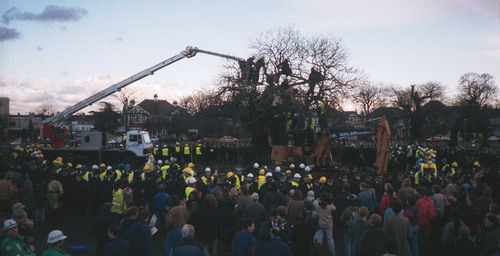
Eviction of George Green, Wanstead, December 1993

The ‘activists’ I spoke to attributed these changes in the views of ‘locals’ to the force of argument. They had spent long hours together in vigils to protect the green, and in that time had the opportunity to develop their points about the global significance of the ‘local’ road-building scheme and hence the political nature of ‘environmental’ issues.

The role of ‘discussion and debate’ in ‘politicizing’ people in social movements is also stressed by a number of sociologists and social psychologists. There is plenty of evidence that discussion and argument can be persuasive.

But there was something else happening at the time of the transformation of these ‘local’ people into ‘political subjects’. This was their participation in the ‘direct action’ itself. While they may have intended their participation to be different (less ‘direct’) than that of the ‘activists’, it was not seen that way by the police, who acted upon the protesters as a whole – as a crowd, in fact.

Put differently, the (unintended) consequence of the ‘locals’ acting ‘with’ the rest of the crowd was police action which served to impose a common experience (of ‘illegitimate attack’) on all, such that the distinction between ‘activist’ and ‘local’ could no longer be easily sustained. In a context when one is treated as ‘oppositional’ by the police, arguments about the ‘political’ nature of road-building will seem more plausible, and those making them more persuasive. Such people come to be seen as ‘one of us’ rather than ‘one of them’, and we might listen to more carefully.

If indeed the Met police ‘spy’ did change his views - and this is something he is reported as denying - we can only speculate about the exact processes behind such a change.

However we can note, first, that environmental direct activists have good arguments – global warming, vested interests, the nature of social change, and so on. But but they always have had good arguments, and these aren’t usually enough to change the minds of serving police officers, security guards or others paid to oppose their actions!

Second there is the accusation that the infiltrator was more than a spy, that he took an active role in the campaigns he was involved in. His actions were not ‘passive’, it is claimed; he changed the very context within which he found himself. It may be hard to think of yourself as exactly ‘the same person’ if you have in effect changed the social environment that gives you your self-definition!

Method: Problems and opportunities of insider research

But what about the question of method?

What about me? When I carried out my ethnographic study, did I come to adopt the worldview of those I studied?

Before answering this directly, let’s point out the two most obvious differences between undercover police officers and ethnographers in the environmental direct action movement.

First and most obviously, the police officer is undercover for a reason – because his or her aim is to find (or, it is alleged, create) 'intelligence' for the purposes of disruption. She or he is insider and against the movement. The social scientific ethnographer is usually neutral or sympathetic. Linked to this, the ethnographer is not usually covert.

Some researchers have tried to justify covert research (such as Laud Humphreys in his classic study of ‘homosexual encounters in public places’, in 1970). But there are practical as well as ethical reasons why most declare themselves to those whose worlds they are researching. For one thing, trying to hide one’s true aims or identity risks discovery, anger and physical assault (such as Laud Humphreys in his classic study etc. etc.)

In my own study, I needed people in the movement to help me with the project, and to do so meant being open about my intentions.
But to be open, to gain trust, to get people to co-operate meant to be part of the campaign. Why should people give their time to a careerist parasite? I chose to research a campaign whose aims I shared. If ‘activism’ is the topic, activists are the best researchers.

So did I ‘go native’ in my analysis? The research was an attempt to say something about the processes by which people change their identities in collective action. It was not a study of the rights and wrongs of the Conservative government’s road programme, or of direct action as a political form, of police ‘public order’ tactics, or of the reality of global warming. Of course I was a subject, with my views on these and other things that people in the campaign talked about. But, for my research, I wanted to understand something of the police view of ‘the crowd’ just as much as I wanted to document and analyse the protesters’ views. By adoption of an ethnographic framework – involving interviews, observations, soundtrack recordings, and collection of archive material – I was able to achieve both of these things.

Returning to the current furore, for ‘crowd psychologists’ just as much as ‘activists’ and any other person, it is impossible not to have an opinion about the extraordinary lengths the UK police went to in order to ‘gather evidence’ on the UK and European environmental protest movements. For a critical discussion of the proportionality, assumptions and priorities that lay behind the fiasco, check out Clifford Stott’s statements on his site:

References

Drury, J., & Stott, C. (2001). Bias as a research strategy in participant observation: the case of intergroup conflict. Field Methods, 13, 47-67.