Sunday, 7 August 2011

Are crowds to blame for the plunging financial markets?

Economics seems to be the last remaining social science discipline to retain a place for ‘mass panic’ in its explanatory models. Thus according to economics commentators, the sharp drop in share values at the end of last week is due to ‘panic’ among investors in the financial markets which in turn is attributed to the supposedly collective nature of markets.

For example, on Friday’s ‘The World Tonight’ on Radio 4,‘City Boy’ author Geraint Anderson explained that the trading floor is an emotionally volatile environment which leads to irrational and damaging behaviour because of the presence of other people. While individuals may be rational, ‘crowds are foolish’.

He is not alone in making such claims. Standard sources describe all the major financial crashes of the last 100 years in terms of ‘panic’. The classic case study of a stock market bubble and crash, ‘Tulipolamania’, was also explained in similar terms by Charles Mackay in his book Extraordinary popular delusions and the madness of crowds (1841):

‘The more prudent began to see that this folly [investing in tulips] could not last for ever. Rich people no longer bought the flowers to keep them in their gardens, but to sell them again at cent per cent profit. It was seen that somebody must lose fearfully in the end. As this conviction spread, prices fell, and never rose again. Confidence was destroyed, and a universal panic seized upon the dealers. … The cry of distress resounded every where, and each man accused his neighbour… Many who, for a brief season, had emerged from the humbler walks of life, were cast back into their original obscurity. Substantial merchants were reduced almost to beggary…’
(p. 95)

To those of us working in other social sciences, the reliance by economists on the concept of panic is both interesting and perplexing. In the study of emergencies and disasters, panic has been largely discredited as an explanation for mass behaviour. Most commentators regard panic in emergencies and disasters as either rare or a myth. Where people flee from harm, this is often the most reasonable course of action rather than an over-reaction. Coordination and helping is common in emergencies, and people even take personal risks to assist others. Where survivors fail to help others, or even harm them during their own escape, it is usually because they are physically unable to do otherwise rather than because they are overwhelmed by selfish motives. In short, outside of economics, there is little evidence for a supposed tendency to rash behaviour in the face of danger brought on by the fact of crowd membership.

The rational individual and the intrusion of mass psychology

The economic subject is in essence a cognitive individual, not an emotional crowd member. S/he is homo economicus, the rational maximizer of self-interest. Mass psychology impinges upon this rational individual as an external and unwelcome intrusion, foisting upon her not just panic but a range of other emotions, including ‘confidence’, ‘optimism’, ‘nervousness’ and ‘fear’:

‘The key to such widespread phenomena [i.e., panic selling] lies in the nature of the crowd: the way in which a collection of usually calm, rational individuals can be overwhelmed by such emotion [mania, then fear] when it appears their peers are behaving in a certain universal manner.’

While ‘confidence’ may be a good thing, ‘over-confidence’ is not, and can lead to irrational behaviour (such as buying too many tulips). Indeed, if too many individuals display either ‘over-confidence’ (or ‘excessive caution’), this can lead to collective disaster.

Economic commentaries offer various accounts of how social influence occurs and hence emotional and irrational behaviour spreads between people. These include ‘herding’ and ‘mimicry’. The most common concept for explaining social influence within and between financial markets, however, is ‘contagion’. The first person to apply this medical concept, which describes the spread of a disease, to social behaviour was the historian and crowd psychologist Hippolyte Taine. Like ‘herding’ and ‘mimicry’, the concept of contagion conveys mindlessness, and hence uncritical and simple effects of social co-presence. And like ‘mass panic’, ‘contagion’ and these other concepts are today more usually found in the biological sciences than the social sciences.

 A frantic scene on a trading floor

The subjects and social relations of economic production and circulation can be characterized, and indeed reified, in various different ways to achieve different effects. For example, the expression ‘money makes the world go round’ places a human product in the position of producer. After endowing the products of labour with their own agency and power, a second step is to naturalize and eternalize these qualities and the relationships they imply. When ‘the economy’ seems to exist as a separate entity in its own right, then those attempting to ‘steer’ it cannot be blamed so easily when there is a recession; and when ‘market forces’ are inevitable, then social change becomes unthinkable. 

In the present case, over-emotional and rash behaviour brought on by supposed ‘crowd’ membership is reified as a separate ‘social realm’, external to individual ‘human nature’. This psychology of the crowd, rather than other features of the system, can then be blamed for the volatility of the financial markets. Explaining financial market crashes in terms of this mass psychology can thereby draw attention away from other possible causes of crisis. Thus, it could be the lack of proper sociality, rather than its excess, that is at the heart of what goes on in a financial crash.

What is a crowd?

Another way of looking at the problem of market crashes is to say that the financial market is not really a crowd at all. Market crashes are caused by people acting as individuals not as crowd members. In good times as much as bad, calm times as well as stressful times, individuals attempt to maximize their gains or limit their losses. But, because the individuals within each financial market do not communicate, coordinate or plan together, of course they are always trying to second-guess the intentions of other individuals. The imperfect attempt to second-guess, again, takes place in good times as well as bad times. Psychologically, therefore, there is no qualitative difference in behaviour between normal trading conditions and crisis: both are individual rather than collective.

The idea that the financial crash is explicable in terms of exactly the same individual imperfect second-guessing as in normal conditions, rather than being due to collective panic, is not new. Keynes explained market behaviour in roughly these terms many years ago. What we as social psychologists can add conceptually, however, is an elaboration of the idea of the crowd that economists use so loosely.

Hence we distinguish between a physical crowd and a psychological crowd. A physical crowd is simply an aggregate of people who are all present in the same physical space at the same time. A psychological crowds is a co-present set of people who see each other as belonging to the same social category: for example a crowd of protestors against racism or a crowd of Manchester United football supporters. While both may be referred to loosely as ‘crowds’, the behaviour of their ‘members’ towards each other will be very different. Moreover, in situations of possible danger or scarcity, the collective outcomes of this behaviour will also be very different.

In a physical crowd, people act for themselves as individuals. When there is a threat (of danger or missing out), those in a physical crowd will experience that threat in relartion to themselves personally only, and will act in competition with others in the crowd to gain the scarce resource or to escape. The net effect may be that there is less collectively beneficial behaviour across the ‘crowd’ as a whole: the exit is blocked, the market collapses, and so on. In the psychological crowd, by contrast, 'my interest' and ‘your interest’ is superseded by ‘ours’. Other people in the crowd are therefore assisted, and members of the crowd communicate in order to coordinate the most effective response in the interests of the group as a whole.

Evacuation behaviour in two virtual reality ‘crowds’

As well as offering conceptual clarification, we can also add an empirical illustration of some of these arguments. We carried out an experiment to look at effects of collective threat under different psychological conditions. The experiment employed a virtual reality visualization of a scene in an underground railway station. In the visualization, people in the scene run towards the exit. There are bottlenecks on the escalator, and there are a number of injured fellow passengers who need assistance. The participant has to decide how to respond. 


We ran the simulation at the immersion laboratory at St Andrews University, and introduced a number of conditions. In one condition, participants were told that their aim was to get to the sales as quickly as possible to get a bargain. This was the ‘physical crowd’ condition. In a second condition, participants were told that their aim was to escape from the station as quickly as possible because there was a fire that threatened the whole crowd. This was the ‘psychological crowd’ condition. In each condition, the visuals (number of other people running, number of bottlenecks and people needing assistance) were identical.

To check the manipulation, we took measures of participants’ social identification with others in the crowd. As planned and expected, there was greater social identification for those in the psychological crowd than the physical crowd. Importantly, there were also differences between these conditions on all three behavioural measures taken. Compared to participants evacuating the station in the ‘physical crowd’ condition, those in the psychological crowd were more likely to help those who needed assistance, quicker to offer such help, and less likely to push others out of the way. In other words, they acted in ways which were of benefit to other crowd members as crowd members and hence in the interest of the crowd as a whole.

What does this mean for real-world evacuating crowds? With a limited exit and a large crowd, the optimum response for the crowd as whole is collective coordination, such as queuing. By contrast, if people act simply as individuals rather than as fellow crowd members in such contexts, their individual ‘rational self interest’ translates into competition among individuals, such as pushing and shoving, which could block those same exits and hence endanger the crowd as a whole.

What does this mean for the psychology of the financial markets? It means that ‘crowds’ per se are not to blame for plunging financial markets. This in turn means that ‘panic’, conceptualized as the intrusion of irrational mass psychology into the smooth workings of the otherwise rational individual, as an explanation for financial crises obscures more than it reveals. If there is dysfunction in the markets – whole economies plunging into recession and even depression – then it is not because people are acting as crowd members. Quite the reverse: it is precisely the fact that people are acting simply as individuals attempting to maximize their own individual interests, and in a setting where others are involved and their actions have collective outcomes, that is the essence of the dysfunction.

References

doi:10.3758/BRM.41.3.957

Mackay, C. (1841). Extraordinary popular delusions and the madness of crowds. Ware: Wordsworth.

Friday, 22 July 2011

Take That! Why Pie-Throwing Lives On

Sunday, 1 May 2011

The narrative(s) of 7-7 and their implications for policy and practice

Following the recent inquest into the London bombings of July 7th 2005,  the Coroner’s report will be delivered this Friday (6th May 2011).

Everyone who has followed the story of the events themselves, plus the inquest into the events some five years later, has had a view on what happened - whether it be admiration, indignation or both.

In the months immediately following the bombings, I carried out a research study on the experiences and actions of survivors. I have also been asked to speak about this event on numerous occasions to many types of audiences over the past five years. When we talk about the London bombings, one thing I have noticed is the way that the narrative of the event has changed over time.

But that’s not quite accurate. There never was a single unitary narrative of the events – it was always disputed and struggled over. But different versions have come to the fore in the mass media at different times. And journalists contact people like me asking us to speak to one or other of these narratives. Of course I have tried to argue for the particular account I think best fits what happened, but that isn’t always the version that some journalists (and others) want to hear.

When the bombs went off that morning in July 2005, I was on the London underground myself. I had just got onto a crowded platform when a dull monotonic announcement requested that everybody leave the station immediately. No explanation was given, and the public response was one of grumbling, grudging compliance. Then, still not knowing why the tubes weren’t running, I joined thousands of others all walking their way to work across London: a surreal experience. At the time, I had an exhibition at the Royal Society. It was only when I arrived that we were told the news – that people were coming out of some tube stations blackened with soot, that there had been explosions. I was at the Royal Society to exhibit our virtual-reality experiment on mass evacuation behaviour from an underground rail station. I was bracing myself then for press headlines with the usual clichés of mass panic and pandemonium, against which my message about commuter behaviour in emergencies would be swamped. But I was wrong. Quite a different set of clichés were mobilized instead.


British bulldog

The dominant theme in the immediate aftermath was one of resilience. But a particular species of resilience. Britain coped. The emergency services were stretched but all coped. Londoners are a tough lot. After all, they had experience of IRA bombs years ago. The British Bulldog spirit prevailed. The implication – although not stated – was that nationals of other countries might not have displayed such calm, order and dignity in the face of threat and carnage. ‘We’ have the stiff upper lip, after all.

Two weeks later, however, the British were presented as a bit more vulnerable, apparently reacting with fear and nervousness to a second – albeit failed – terrorist attack. But, later, as those present took to the witness box, this picture of panic late gave way to one of heroism as the actions of those who tackled the would-be bombers were described.

The heroism narrative

It was a ‘heroism’ narrative that has, recurrently, been used in some quarters to explain what happened among the survivors at 7-7. The idea has been a preoccupation of journalists – who want to know whether there was a particular type of ‘personality’ who was active or cooperative in emergencies such as 7-7. Were there born leaders among the sheep? What kind of people reacted with courage and decisiveness when others were frozen with fear or panicking?

One of the accounts of the immediate aftermath of the bombings, which emerged from the inquest, thus highlighted the bravery of a small number of (named) individuals who risked their own lives for others. Indeed, what is said to be all the more remarkable about this is the backdrop of ‘bystander apathy’. The narrative suggests that the non-heroic were actually worse than useless in their response.

In our study of the London bombs, we found similar stories of heroism from those we interviewed who were on the bombed trains. The same narrative was also prevalent in the many survivors’ stories from 9-11 – both in popular publications and in the academic literature. But in both these events we found two other features of the public response to put these examples of heroic help into a slightly different perspective than the news stories. In fact one which puts the rest of humanity into a rather better light than that offered by the heroism narrative.

The first thing to say is that heroic help was indeed the exception. That kind of help where the helper risked their own life and safety for others occurred – and in all cases that we are aware of these others were complete strangers; but it was rare.

On the other hand, we know that the survivors were left alone in the bombed out carriages for some time before the emergency services reached them. And yet many did survive despite their horrific injuries. The second thing to say then is that mundane helping was commonplace. Where the journalist always wants to talk about the exceptional behaviour of the few, as a psychologist I am interested in the behaviour of the many. That is actually not only more interesting but more important. If many people had behaved entirely selfishly – or had panicked – many more would have suffered and died. Many of the acts of help – such as sharing water, offering words of reassurance, sometimes even tying tourniquets – were not necessarily heroic in the sense of involving a risk to one’s own life.

The third point is that many of the acts that took place between people in the bombed out trains, as they lie there and as they managed to make their way out, might not even be classed as help at all. They were more like acts of courtesy or respect. They were the small acts of social acknowledgement that allow people to coordinate – especially in situations where there is little safe space available. These mundane acts of courtesy helped people to survive collectively as much as the acts of heroism, for they provided spiritual uplift and hope as well as physical relief:

I remember walking towards the stairs and at the top of the stairs there was a
guy coming from the other direction. I remember him kind of gesturing;
kind of politely that I should go in front—‘you first’ that. And I was struck I
thought God even in a situation like this someone has kind of got manners
really. Little thing but I remember it. (quoted in Drury, Cocking, & Reicher, 2009, p. 79)

The events of 9-11 have been the subject of even more stories of personal heroism than 7-7, but in fact the evacuation of the twin towers required relatively little in the way of heroic help but rather a lot of mundane coordination. Relatively few among those evacuating were injured; most only required others to move down the stairs together with them at a shared pace, to hold the door for the next person, to respect their pace and so on. This, not numerous acts of heroism, was what enabled so many people to survive that disaster.

The Emergency Services as hero and villain

The Emergency Services were at first depicted as collectively and organizationally capable and competent in the news accounts of the bombings. The Inquest added to these stories of individual heroism.

However one of the predominant accounts that emerged in the inquest was of the emergency services as at fault in their response – a reappraisal of the original gloss put on their actions on the day. The police radios didn’t work underground. There was a delay in sending ambulances to the scene of the attacks. And, perhaps, most upsetting in the eyes of some of the public and mass media, the fire brigade did not go down the tunnels immediately.

In a recent interview on the BBC, Jennifer Cole of RUSI argued against this easy attack that has been worked up on the emergency services. She pointed out that while there may have been legitimate complaints about the command and control of the emergency services, the actual behaviour of the emergency services personnel on the ground was probably as good as it could have been. For example, the criticisms of the fire brigade for not going down the tunnel seemed to be based on the assumption that they should be acting as paramedics when they were not equipped to do so.

The key point is that it is not clear that, had the emergency services acted differently, more lives would have been saved. We shall see on Friday whether the Coroner’s report bears this argument out, but it fits with the analysis we provided based on our own study of the London bombs, and indeed it has deeper and broader implications.

These are that, in emergencies, the public – including the victims themselves – are inevitably the first responders. They are on the scene first; they are more numerous than the emergency services; and, importantly, they are motivated, competent and mostly calm enough to act effectively.

The major complaint of those on the London underground trains that were affected by the bombs on July 7th 2005 was the lack of communication about what was going on. A lack of information creates unnecessary anxiety and prevents people from making informed judgements about their actions.

A major recommendation from many of those who were survivors or witnesses to the events on the day was that first aid kits should be made readily available and accessible on the tube trains. People had to improvise bandages from their own clothing. Publicly available first aid kits would be a recognition of the fact that the public are not only motivated and capable of acting as the fourth emergency service in any major incident, but that they are also expected to play this role.

Competing narratives of mass emergency behaviour

I started researching emergencies such as 7-7 because I was interested in group behaviour. But I have since found the way that behaviour is talked about in such events is of importance in its own right. Narratives of resilience and heroism are, like the well-known media image of ‘mass panic’, not simply descriptions of events. They can operate as rationales for practice, justifications for decisions, and reasons for praising some and blaming others. They are highly consequential. If everyone is going to panic, there is no point installing communication systems. But if resilience is widespread – more widespread than the heroic few or the bulldog British – then there is every reason to acknowledge and facilitate public involvement in their own safely and security.

References

Drury, J., Cocking, C., & Reicher, S. (2009). The nature of collective resilience: Survivor reactions to the 2005 London bombings. International Journal of Mass Emergencies and Disasters, 27, 66-95.

Drury, J., Novelli, D., & Stott, C. (2013). Psychological disaster myths in the perception and management of mass emergencies. Journal of Applied Social Psychology, 43(11), 2259-2270.

Friday, 18 February 2011

Egypt and identity politics

Emotion, collective action and social change.

Social scientific accounts of crowd behaviour used to treat emotions and meaningful political aims as polar opposites. On the one side there were crazes, fads, riots, mass hysteria, mass panics and so on. On the other there was the lone individual, bastion of rationality and logical decision-making. 'Politics' could only take a collective form through the highly structured and organized machinery of the political party system, and collective pressures could only be exercised within the system through trade unions, lobby groups and other institutionalized forms of representation.

This dichotomy between the crowd and politics was a legacy of the ideas of Gustave Le Bon and those others who, in late 19th century Europe, sought to develop a theoretical tool to combat 'the mob', which was seen as a threat to the established order. The distinction between emotion and 'rationality' was reproduced in the 'collective behaviour' tradition in psychology and sociology, and even remained in the (badly) hidden assumptions of ultra-rationalist resource mobilization theory.

The social identity approach began as a 'cognitive' reaction against those 'irrationalist' theories that explained collective action in terms of primitive emotions or instincts (such as frustration-aggression). In the past 10-15 years, however, there has been a concerted attempt by social identity researchers to restore the place of emotions in the understanding of group and intergroup life. Alongside conceptual advances - like the acknowledgement that emotions entail 'knowledge', and that knowledge can be 'hot' - there are very many empirical studies which now converge around the view that emotions are important causes and consequences of collective action.

Anger and collective action

Group-based emotions, such as anger, can be determined by how the group interprets an intergroup event. Feelings of 'injustice', and hence anger at intergroup events, are a key predictor of collective action, as they motivate the group to confront those responsible.

This can be seen in the recent protests in Egypt, which have been explained in terms of a growing gap between rich and poor. While the private sector has benefited recently from economic liberalization, up to 40% of Egyptians are still living on $2 a day. A sense of 'injustice' is not a new experience for many Egyptians. There has been 'a brutal and abusive state security apparatus and a total absence of social justice'  for a number of years.

Empowerment and collective action

Commentators and participants suggested that Egyptians were inspired by the uprising in Tunisia, which occurred only weeks before (just as those in Libya, Bahrain and other places are being inspired by Egypt). There are reports that video footage and updates on social networking sites made others aware of the protests taking place in Tunisia, and inspired them to act too.

So, in the language of social psychology, there was not only a sense of 'injustice' but also a sense of efficacy: of power.

Day 4 of the Egyptian uprising (28/01/11):
SHARIF ABDEL KOUDDOUS: "Ahmad, what effect has the uprising in Tunisia that led to the ousting of President Ben Ali had on protests in Egypt?"
AHMAD SHOKR: "Well, I think it’s left people really inspired. And it’s you know, many people, for the first time, believe that revolution is possible, that political change from the street is something that can happen. [ ] there’s no doubt that people have definitely been incredibly inspired. I mean, people that I know personally, who just a few weeks ago would have never thought to set foot in a demonstration, who were, for the most part, completely depoliticized, are taking to the streets, are fired up and believe that being on the streets and calling for change can actually do something, can actually make a difference right now."

The subjective sense of power - empowerment – is a predictor of collective action. Importantly, it can also be a result of collective action. The concept of empowerment contains 'efficacy', but it is more than that. It implies (positive) emotion as well as cognition. And it refers to a social relationship of unequal power (that feels bad) which is challenged or overcome (which feels good).

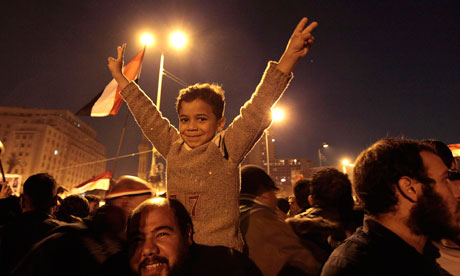
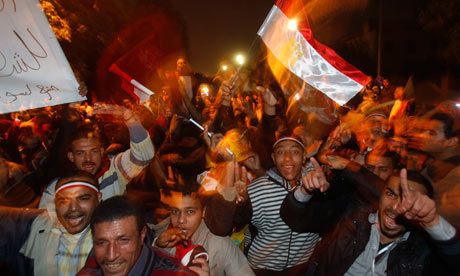
The pictures coming out of Egypt last Saturday (12th February), when Mubarak resigned, seemed a vivid illustration of the emotional experience of empowerment in collective action. People were joyful, uplifted, exhilarated, euphoric - you could see it their faces.

‘In Tahrir Square, we lost our fears and found ourselves’
The Observer, Sunday 13 February 2011

Day 18 - Mubarak flees (11/02/11)
ANJALI KAMAT: "I can’t explain to you what the mood is like here. It’s indescribable. People are just crying with happiness. They’re jumping up and down, so proud to be Egyptian, so proud of what they’ve achieved over the past two weeks. Everyone’s talking about how they did this in nineteen days. People are just ecstatic. They’re doing cartwheels in the middle of the street. They’re jumping up and down. Whole families are coming from across Cairo. I’m just walking a little bit out, and the traffic is unbelievable. Everyone’s honking their cars; it’s like a wedding party. It’s an unbelievable celebration, the biggest goodbye party ever. Everyone is so thrilled that Mubarak is resigning."

The Elaborated Social Identity Model explains this relationship between empowerment and emotion by suggesting that acting to change the world in a way congruent with our identity gives us a sense of agency. We can see that we are agents (not mere objects) through our own action and its impacts. Just as alienation is aversive, so agency feels good. It feels joyful. It makes us happy. It has even been shown to be a predictor of health outcomes, such as lowered blood pressure and enhanced immune functioning.

'I have friends on anti-depressants who, over the last 20 days, forgot to take their pills and have now thrown them away. Such is the effect of the Egyptian Revolution'
http://www.bbc.co.uk/news/world-middle-east-12393795

Empowerment: collective joy as politics

The role of positive emotion has received much less attention in the research literature on collective action than negative emotions such as anger and grievance. This is somewhat surprising given how prominent positive emotions are in the subjective accounts of collective actors. When they talk to us about collective actions that succeeded in some way – actions that were congruent with their collective identities – they are joyful; they beam and smile and laugh. They feel happy at the sheer memory. And they refer to 'empowerment'.

‘Empowerment’ is a term and an idea with its roots in movements for progressive and even revolutionary social change. Despite its co-option by management and business (try a Google search and see what I mean), the term is still meaningful to a lot of people involved in social movements.

Despite the claims of Le Bon that crowd power is 'illusory', the phenomenological - the subjective, the experiential - and the objective world of real social relations of power are connected in the crowd. Empowered collective identities are that connection. The more people that feel joyful, confident and positive about collective action to change their world in a direction defined by their shared identity, the more such action will take place.

Mubarak's resignation prompted celebrations in Tahrir Squarein Cairo.
Photograph: Suhaib Salem/Reuters

When it occurs, successful collective action feels like a form of self-realization – except that the self is that of the wider group (not just the individual), and the aims realized might only have emerged in the course of the struggle (rather than pre-existing the struggle as an ‘essence’). Either way, the experience is positive, exhilarating, uplifting. It is to be a subject of history rather than a cog in a machine:

Day 17, the day before Mubarak’s 'resignation' (10/02/11)
AHDAF SOUEIF: "I think what has happened here is that people have they’ve found their voice, and they’ve found their personality. In other words, there is a definite sense that this regime had been not only robbing people of their country, but had been alienating people from their own personalities. And now they have found it. And you see people saying, "They told us we were divided. They told us we’re extreme. They told us we’re ignorant. But here we are, and we’re great." And this is why this is just not going to go away."

If we are right that emotions and meaningful political aims are not after all polar opposites but interconnected, then the crowd can be understood as a conscious agent of social change and not merely a symbolic outburst.

By John Drury and Sanjeedah Choudhury


References

Drury, J., Cocking, C., Beale, J., Hanson, C., & Rapley, F. (2005). The phenomenology of empowerment in collective action. British Journal of Social Psychology, 44, 309-328.

Drury, J., & Reicher, S. (2009). Collective psychological empowerment as a model of social change: Researching crowds and power. Journal of Social Issues, 65, 707-725.


Wednesday, 26 January 2011

Research on psychosocial resilience in first responders

Psychology awarded £50K for research on psychosocial resilience in first responders

Student’s crowd research shows why we love the terraces and hate the Tube

Student’s crowd research shows why we love the terraces and hate the Tube

Sunday, 23 January 2011

Why do ‘stampedes’ happen at crowd events?

On a regular basis, the mass media report tragedies at crowd events intended as positive, uplifting experiences for their participants. Recent examples include the deaths at the Cambodian Water festival  and the Love Parade in Duisberg, Germany. Very often, such reports describe mass casualties at religious pilgrimages – such as the recent tragedy in India.

There is a recognizable pattern to the reporting of these kinds of events. Inevitably, there is a ‘stampede’, which is caused by ‘panic’ in the crowd. These loaded terms form an off-the-shelf framework for not simply describing but also offering a ‘common sense’ explanation of such events.

‘Stampeding’ is the behaviour of herd animals. The word ‘stampede’ therefore conveys something different from the word ‘fleeing’. It implies that the behaviour is primitive, instinctive

‘Panic’ is a psychological state. It implies a rashness or irrationality in response to (perceived) danger, and hence a failure to consider or be constrained by one’s critical judgement or the usual social rules.

The clear implication in describing these fatal crushes as ‘stampedes’ brought on by ‘panic’ is that people are more likely to respond in these ways in crowds than they are alone. They are more credulous, more driven by simple emotions, more excitable, more impulsive, more barbaric. In crowds, apparently, we forget the social obligations that structure our normal interaction. Instead, acting as asocial individuals, we trample each other and even kill ourselves in our attempts to escape perceived danger.

In the accounts of tragedies at religious pilgrimages, there is an implicit or sometimes more explicit linkage of this mass psychology to the exoticism and religious beliefs of the victims. Whether or not it is intended, the news accounts can sometimes be read as explaining such stampedes as partly due to the nature of the particular groups involved: they are presented as especially credulous, excitable, and so on.

By contrast, the notion of the intellectually inferior crowd – whether due to the ‘group mind’ or ‘personality’ – is out of favour with psychologists. And the idea of ‘mass panic’ has been regarded as a ‘myth’ by sociologists for over 50 years.

Therefore, when crowd events end in tragedy, when the news reports a ‘stampede’ due to ‘panic’ in the crowd, I am often asked whether the social scientists haven’t got it wrong after all. Is there in fact something about events such as religious pilgrimages that marks them out as exceptions, i.e., as the types of events where ‘mass panic’ is more likely to occur? If not, how can we explain tragedy on such a scale?

One of the problems in giving a categorical answer to such questions is that the journalists’ accounts are often all we have to go on. Events are often described sketchily, the same source is often used across ‘different’ news accounts, and details and witnesses are not as extensive as we would like. The images of people walking over each other, falling off bridges and so on say little about the context of the single episode or what was going on in the mind of the person being depicted.

But usually even the most limited and cliché-ridden accounts contain snippets that problematize and undermine the ‘mass panic’ explanation.


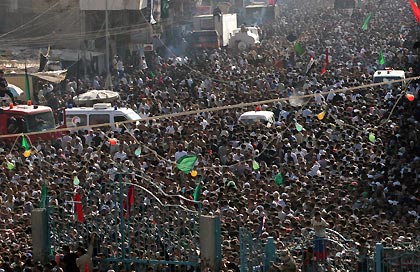
The death toll in the event was about 1000, with another 465 individuals injured. At first sight, news reports suggest that this event fits the pattern for ‘mass panic’:

1. sudden (exaggerated?) fear of a suicide bomber, spreading (like 'contagion') through the crowd.
2. limited exit due to the large numbers and lack of space.

These are indeed the classic conditions for ‘mass panic’ to occur.

Some of the behaviours cited also chime with the ‘panic’ explanation:

1. the vulnerable (elderly, women etc.) being crushed,
2. people all pushing each other,
3. apparently desperate suicidal-sounding acts of escape (jumping off the bridge), and
4. the usual reference to a 'stampede' (‘directionless’, instinctual fleeing)

Yet there are a number of other features in these same news accounts which muddy this simple picture:

1. The BBC Middle East analyst Roger Hardy is quoted as saying that, because of ongoing radical Sunni attacks on big Shia gatherings, it was 'not unreasonable' for the worshippers to be 'nervous'. This undermines a little the notion of the pilgrims' fear of a suicide bomber being irrational or exaggerated.
2. There were many attempts to help. In fact, someone is described in a couple of media sources as dying in his attempts to rescue people from the river. This turns around the process in the ‘panic’ account where deaths occurs because of ‘self-preservation’.
3. Some said that they were physically unable to help others because of the crush: "They were crying, shouting out 'please rescue me', but there was no way to help them," said Hadi Shakir, 25, a street trader. (Guardian).
4. Some people said they dived into the river to save themselves (by swimming) ; others fell in due to the crush (rather than dived).
5. In the aftermath, there were statements blaming the authorities for the lack of guidance given to the pilgrims in relation to the levels of density. Put differently, the crush itself might be understood as something which is much more an issue of crowd management than crowd psychology.

It can be argued that what happens to people on becoming part of a large crowd is not loss of control but loss of view. Within a large, dense crowd, one often cannot see how much congestion there is at the head of the crowd, whether people up ahead have stopped, or whether one is walking into a blind alley. The authorities and those overseeing the event have this kind of overview, however - and with it the responsibility to communicate with and marshal the crowd appropriately. From the little information that was put out regarding the official report into the Baghdad event, it seems possible to conclude that the tragedy was preventable had it been managed differently.

This is not to deny that some isolated individuals in the Baghdad crowd may have panicked, or that some may have acted selfishly, or that many were frightened. Nor is it to deny that in some crowd events people display more individualism (personal selfishness) than in others, and that this can contribute to a tragic outcome. To know whether a physical crowd event is also a psychological crowd event, we have to know the extent to which behaviours are socially shared and socially sanctioned. Not just any thought or emotion spreads through a crowd.

Nor is this to deny the importance of the ‘physics’ of crowd events, both as a dynamic force and as a constraint. Sometimes sheer physical pressure pulls people along, and what may appear as intentional or motivated is not. And sometimes people want to coordinate and to help others, but they are physically prevented.

We gain little and lose a lot by use of the terms ‘mass panic’ and ‘stampede’ to describe mass fleeing behaviour. They obscure more than they reveal about collective psychology in stressful events. It is not a coincidence that they are regularly wheeled out as explanations for tragedies by those who might be blamed for the events – the negligent event organizers and safety managers. To locate the cause of the tragedy in the inherent foolishness and selfishness of the crowd is to absolve oneself of responsibility.

A long-term aim in our research group is to look at how extremely large mass events such as religious pilgrimages go right and how they go wrong. Methodologically this means taking seriously the accounts of pilgrims themselves, rather than studying just their observable behaviour and trying to infer from that their perceptions, beliefs and emotions. It also means looking at how those managing the crowd act and think. What are their beliefs about crowd psychology, for example. How do these impact upon their management practices and, in turn, on the experience of those they manage?

References.


Drury. J., & Reicher, S. (2010). Crowd control. Scientific American Mind, November/December 2010, 58-65.

Drury, J., Cocking, C., & Reicher, S. (2009). Everyone for themselves? A comparative study of crowd solidarity amongst emergency survivors. British Journal of Social Psychology,  48, 487-506. DOI:10.1348/014466608X357893