Talking about Hillsborough: ‘Panic’ as discourse in survivors' accounts of the 1989 football stadium disaster Cocking & Drury (2013) Journal of Community & Applied Social Psychology
ABSTRACT
Popular representations of crowd behaviour in disasters are often characterised by irrationalist discourses, in particular ‘mass panic’ despite their rejection by current scientific research. This paper reports an analysis of four survivors’ accounts of the 1989 Hillsborough disaster to investigate if and how they used the term ‘panic’. Reference to ‘panic’ occurred frequently, but more detailed analysis found that their accounts did not match the classic criteria for ‘mass panic’ (e.g. uncontrolled emotion and selfish behaviour). Indeed, participants referred to ‘orderly’ behaviour, and cooperation, even when they said the threat of death was present. ‘Panic’ was therefore being used as a description of events that was not consistent. A discourse analysis of usage suggests that participants used ‘panic’ not only to convey feelings of fear and distress but also to apportion culpability towards the actions of the police who they considered responsible for the tragedy (as indeed recent independent research has confirmed). It is concluded that the term ‘panic’ is so deeply embedded in popular discourse that people may use it even when they have reason to reject its irrationalist implications. Alternative discourses that emphasise collective resilience in disasters are suggested.
Copyright © 2013 John Wiley & Sons, Ltd.
Key words: mass panic; social identity; collective resilience; Hillsborough football disaster; discourse
analysis
Link to article: http://onlinelibrary.wiley.com/doi/10.1002/casp.2153/full
Tuesday, 21 May 2013

Sunday, 13 January 2013
From the local anti-roads protest to social and psychological transformation
Anti-roads
direct action – camps, tunnels, tree occupations – has recently been in the news.
The
development of anti-roads camp near Hastings has led to speculation that
there might emerge an anti-roads movement like that of the 1990s, in response
to the government’s revival of the national roads programme,
In the 1990s,
my PhD research was focused on the No M11 Link Road Campaign, in Wanstead and
Leytonstone (east London), and identified a number of connections between the
social issue of road protests and psychological issues.
The starting
point of the research was an analysis of the participants’ own understandings –
of themselves, their actions and their social worlds. This analysis revealed a
number of contrasts with the understandings of those outside the anti-roads
movement. First, there was the question of ‘politics’. At that time, many
commentators were bemoaning the apparent indifference of young people to
politics. Yet this pessimistic view was based on a narrow conception of what
counts as ‘politics’; while many of the No M11 participants did not vote for
the political parties, they certainly saw their activity as a form of politics;
and they were deeply engaged, informed and passionate about it.
What was that
‘political’ activity? Whereas for most extra-parliamentary groups political
action consisted of ‘protest’ and demonstration marches, the No M11 participants rejected
this model in favour of ‘direct action’. Unlike ‘protest’, ‘direct action’ did
not mean simply asking the government to stop road-building, but actively preventing
this road-building through their own activities, such as occupying construction
sites.

The third
contrast was in terms of how this direct action was understood by those inside
and outside the campaign. The campaign maintained an ethos of ‘non-violence’,
and regarded any of those within the group who transgressed against this
principle as the exception. But those policing the campaign understood the
campaign as ‘violent’ because of damage caused to property (such as site fences), and they saw those
in the campaign who they accused of physically assaulting police officers as
representative of the whole group.
This last
contrast had a number of psychological consequences for campaign participants. Instead of being treated by the police as the respectable middle class
residents they felt themselves to be, they found themselves being treated as an oppositional group. This led
them to see themselves as oppositional. For
them, the local anti-roads campaign had initially been essentially about ‘saving Wanstead’; but now it was about opposing
the national roads programme, which they saw as being forced through by
government, using the police as a ‘political’ battering ram.
The M11 link
road was completed, but the government’s subsequent abandonment of the national roads
programme was widely attributed to the disruption caused by the campaigns in
Wanstead, Newbury, Fairmile and other places. In effect, campaign participants from
the No M11 and other groups succeeded in translating their own understanding
of road-building into ‘public opinion’. Road-building was now seen not just as a
‘technical’ matter, to be decided by highly controlled public enquiries, but as
a deeply political and controversial issue that groups could affect outside the
usual ‘political’ channels. Many participants’ newly political
understanding of the government’s roads programme became extended to an opposition to ‘car
culture’ and indeed to global environmental ‘injustice’. Hence the extension of
their participation from the local campaign to the anti-car Reclaim the Streets,
and from there to the worldwide anti-capitalist movement, made perfect sense.
As well as
these changes in their participation in collective action, for many people
there were changes in their personal lives. They made new friends, but
fell out with other people that they used to regard as friends. They changed
their consumer habits to become more ‘ethical’. They changed their views about
the importance of a respectable appearance and lifestyle. And many no longer
wanted anything to do with the police, even if their home was burgled.
The aim of my
research was to understand these processes of change. The work led to the
development of a new
model of identity change in collective action. We argued that identity was
the hinge between the psychological and the social, and helped explain the links between
experiences in the campaign and various profound psychological changes. Specifically,
we suggested that, through their identity-based action in the campaign ('defending Wanstead’, for example), many participants inadvertently changed the
very context (their relationship with others, such as the police and
government) that defined their identity. It was through construing the action
by others (i.e. police) as representative of a wider category of ‘injustice’,
and also in-group
boundaries as much broader (‘all those affected by injustice’), that experiences
in the No M11 anti-roads campaign led to wider social movement participation
and indeed created the sense many had of being ‘a different (radicalized, empowered)
person’.
One of the
research projects I am currently supervising is looking more closely at similar
psychological changes to those I observed at the No M11 campaign. The campaign
we are studying is one in Scandinavia where ‘locals’ are coming to identify as
‘activists’. They are also reporting changes in their personal lives that, on
the surface, are not obviously connected to the ‘environmental’ campaign they
first got involved in. The research will examine their construals of the actions they are involved in. We will examine the
extent to which the categories that participants use to conceptualize and talk about social
relations in the campaign are changing and are being applied to other
areas of their lives, leading to the observed changes in behaviour. What makes
them define a phenomenon in the campaign as ‘the same’ as one in the home, for
example? Judging by what we have seen in the anti-roads protests of the
1990s, this research is important not only for what it tells us about the
profound phenomenological impact of participation in collective action, but
also for the social and political significance of some of these psychological
changes.
Reference
Wednesday, 12 September 2012
Hillsborough and ‘crowd control’
The Independent Report into the 1989 Hillsborough football crowd tragedy has found that police made
‘strenuous efforts’ to shift blame for the 96 deaths to fans themselves. In
today’s news coverage, the disaster itself is sometimes described
as a ‘failure of crowd control’. These words echo the conclusions of the 1990 Taylor enquiry into the tragedy, which recommended all-seater stadia for
English football grounds.
The words ‘crowd
control’ are worth considering for a moment. Whenever my own research and
specialism is described as ‘crowd control’ (which is quite often), I try to explain that
this is wrong in important ways. I teach a course on 'crowd safety management'
to crowd safety and events professionals, and the classic statement of the
issue we refer to when we discuss this topic is that by Fruin, who is perhaps
worth quoting at length:
‘Although the
terms crowd management and crowd control are often used interchangeably, there
are important differences. Crowd management is defined as the systematic
planning for, and supervision of, the orderly movement and assembly of people. Crowd
control is the restriction or limitation of group behavior.’ (Fruin, 2002, p.
6).
Fruin goes on to say
‘Inappropriate or poorly managed control procedures have precipitated
crowd incidents rather than preventing them.’
Or,
the way I put it in my lecture: ‘Approaching the crowd with
a view to crowd control risks undermining crowd safety.'
Why? Part of the
reason, I would argue, hinges on the dynamic relationship between crowd
behaviour and the representations of
crowds held by those responsible for crowd management (or crowd control). For crowds
only need to be ‘controlled’ when someone thinks they represent a problem.
Broadly, there
are two dominant types of representation of 'crowd problems' needing ‘control’.
These can be found in both popular discourse and in academic accounts. The
first suggests that, in crowds, there is a process of submergence, whereby individuals lose their sense of self and hence
their intelligence and self control, becoming ‘swept up’ by any sentiment
or behaviour spreading through the mass. The second representation, convergence, suggests that problematic
crowds consist of problematic individuals – people who are already lacking in
intelligence and self control – who in the crowd act as they do alone ‘only
more so’, as Floyd Allport put it. These two accounts are often employed in loose
combination in order to explain what is seen as irrational or mindless
behaviour in crowds.
In my lecture on
‘crowd management versus crowd control’ on the crowd safety management module, one
of our key examples is the Hillsborough tragedy. As the report published today
reminds us, certain newspapers, most notably The Sun, claimed that the crushing
of fans in the football stadium was due to ‘football hooliganism’. The
journalists and the police said the crowd that day was inherently a problem because it represented the convergence of
drunken individuals seeking gratuitous violence and ‘disorder’.
The cruel irony
is that these fans that were vilified were the very people trying to save others,
and in some cases risking their own lives to do so. As part of our ESRC-sponsored study of mass emergency behaviour, we interviewed some survivors
of Hillsborough tragedy, who described a deeply harrowing scene yet also one of
great humanity, as illustrated in the following extracts (taken from Drury, Cocking,
& Reicher, 2009):
‘The behaviour of many people
in that crowd and simply trying to help their fellow supporters was heroic in
some cases. So I don’t think in my view there was any question that there was
an organic sense of … unity of crowd behaviour. It was clearly the case, you
know.. it was clearly the case that people were trying to get people who were
seriously injured out of that crowd, it was seriously a case of trying to get
people to hospital, get them to safety.. I just wish I’d been able to.. to
prevail on a few more people not to.. put themselves in danger.’
‘It should be source of great
pride to those people I think because you know, they were clearly in control of
their own emotions and their own physical insecurity I mean a lot of people
were very.. as I was you know.. you’re being pushed, you’re being crushed when
you’re hot and bothered you’re beginning to fear for your own personal safety
and yet they were I think controlling or tempering their emotions to help.. try
and remedy the situation and help others who were clearly struggling’

Picture courtesy of http://menmedia.co.uk
However, it wasn’t simply after the event that the
police explained the disaster as due to drunken ‘hooligans’.
Crucially, this view of the crowd was at the forefront of all their planning and
the responses they made during the tragedy. This has been shown both in published research and is clear from numerous statements in the Independent Report
published today:
‘It is evident
from the disclosed documents that SYP [South Yorkshire Police] were preoccupied
with crowd management, segregation and regulation to prevent potential disorder
... The Fire Service, however, raised concerns about provision for emergency
evacuation of the terraces’
(p. 11)
And again on page
12:
‘a policing and
stewarding mindset predominantly concerned with crowd disorder ... the delay in
realising that the crisis in the central pens was a consequence of overcrowding
rather than crowd disorder.’
And again on page
15:
‘the ‘prevention
of hooliganism’ and ‘public disorder’ was the main priority. The custom and
practice that had evolved within SYP for packing the pens was concerned primarily
with controlling the crowd.’
‘Crowd control’ meant
treating fans like animals, neglecting their safety. As Fruin says, crowd
control is the ‘restriction or limitation’ of crowd behaviour – and this is done
when someone regards that crowd as a ‘problem’. Crowd control is achieved with means
such as barriers or coercion, which risk injury and even fatalities in the crowd.
These days, the leading crowd event safety experts agree that many problems in crowd events –
including some of the most well-known crowd disasters – are due to problems in
crowd management. Examples would
example the failure to plan for sufficient space for the size and flow speed of
the crowd, and the failure to communicate adequately with the crowd.
This kind of
analysis, which moves attribution for crowd disasters away from the supposedly
inherent psychological problems of the crowd (whether of ‘convergence’ or ‘submergence’) to
deficiencies in management and planning, is a positive development. It suggests
that crowd disasters are not simply something that ‘just happens’ from time to
time due to the inherently primitive psychology of the crowd; rather, crowd
disasters are preventable through improvements in knowledge about, and hence to the practice of,
crowd safety management. It is far too late for the Hillsborough
tragedy, of course, but the increased scientific interest in the psychology of crowd
safety management, in both research and academic contexts, is a vital
contribution to the critique of ‘crowd control’ and hence to safer crowd events
in the future.
References
Drury, J., Cocking, C., & Reicher, S.
(2009). Everyone for themselves? A comparative study of crowd solidarity among emergency survivors. British Journal of Social Psychology, 48, 487-506.
Fruin, J. J. (2002). The causes and prevention of crowd disasters. Originally presented at the First International
Conference on Engineering for Crowd Safety, London, England, March 1993
(Revised exclusively for crowdsafe.com, January 2002.)
Wednesday, 1 August 2012
Friday, 20 July 2012
Wednesday, 28 March 2012
The logic of ‘panic buying’
This week, the government (and the mass media) have
been criticized for promoting ‘panic-buying’ of petrol in the context of a possible tanker drivers strike. Here
at Sussex University, we have been looking at the use of the word ‘panic’, and
at the kinds of behaviours that are sometimes labelled in this way. We have also
worked alongside emergency planners and crowd safety management professionals
on this question of communication in possible emergency situations. Based
on this work, there are three simple points to make about the current situation
of supposed ‘panic-buying’.


Run on the Seamen's Savings' Bank during the so-called ‘panic’ of 1857
(courtesy of Wikipedia commons)
1, Don’t say ‘don’t panic’
The first point is that the advice ‘don’t panic’ is worse than
useless. When those in authority say ‘don’t panic’, or even ‘stay calm’,
the rest of us know by this that there is definitely something we should be
anxious about – for why else would they be warning us in this way? And why else
should they be so concerned about our emotional responses if not because they
think there is something that we might ‘panic’ about? In the present case, the
advice that there was no crisis, but that people should fill up their cars just in case, was as good as advice to act exactly as though a crisis was imminent
and therefore to fill up as much as we can.
2, Belief that there is ‘panic’ makes it logical to act individualistically
The advice ‘don’t panic’ is based on the mistrust by the
government of the (potentially irrational) ‘masses’. In turn it sows mistrust.
It does this in two ways. First, the advice communicates that the government is
holding something (scary) back from the public, so creates mistrust between
public and government. Second, reference to ‘panic’ risks creating mistrust
amongst members of the public themselves. When the government and the mass
media tell us that our neighbours are ‘panic-buying’, we imagine those around
us acting individualistically, rushing to hoard goods for themselves. And if
we imagine that everyone else is acting this way, it becomes foolishly
self-sacrificial to do otherwise oneself. Rather, it becomes completely logical
to look after number one. The result is that we trust our neighbours less to
act patiently and in the collective interest.
3, ‘Panic buying’ is not panic
The third point is that the large queues and the rush to stock up
does not really fit the criteria for panic. Journalists reporting from
the scene of petrol queues note with surprise the calm, boredom and stoicism of
the people waiting in line. ‘Panic’ is a clinical condition marked by an
excessive fear and anxiety reaction, the physiological signs of which include
raised heart rate, shortened breath, sweating and so on. This excessive anxiety
prompts reckless, uncontrolled behaviour. People queuing for petrol
in so-called ‘panic buying’ may be acting in their personal interest
rather than the collective interest, but this is cognitively driven rather than an instinctive ‘flight or fight’ response. The queuing and bulk-buying is logical - given people's reasonable beliefs about others’ behaviour and their reasonable mistrust of the authorities. And there is no spread of irrational beliefs or
emotions through these crowds. As I have argued elsewhere, there is no
evidence to support the argument that crowds are susceptible to the uncritical spread of simple emotions through so-called ‘contagion’:‘mass panic’ is a myth.
It is often the mass media, more than the politicians, who mobilize
the ‘panic’ cliché to describe consumer queuing and stock piling. It is perhaps
encouraging to report, therefore, that not all journalists are so lazy. After
an interview we gave on Radio Leicester to discuss our ESRC research project on mass emergency behaviour, the reporters were so convinced by the argument that
they made it a policy not to use the term in future.
However, we don’t think that solutions to the problems produced by mutual
mistrust and individualism lie only or essentially in changing the messages given out
by those in authority. It was notable that, in his nervous back-tracking, David
Cameron referred to ‘resilience’ as just a quality of the state and its
functionaries. We have been exploring the informal resilience of crowds, which expresses itself in solidarity and is a function of shared social identity among crowd members. We are currently running some experiments to show that, when
people think of themselves in terms of their social identities (e.g., ‘me as a
member of my community’) they will be more cooperative, less ready to push in
to queues, and more willing to share dwindling supplies with strangers than
when they think of themselves in terms of their personal identities (e.g., ‘me
as distinct from others in my community’). If the outcomes of the behaviours labelled as 'panic-buying' are dysfunctional for the collective (e.g., more acute shortages for most as the minority hoard goods) it is precisely because people in the crowd are acting reasonably as individuals, rather than as members of a psychologically united crowd; cf. Mintz, 1951.)
References
Drury, J., Cocking, C., & Reicher, S.
(2009). Everyone for themselves? A comparative
study of crowd solidarity amongst emergency survivors.British Journal of Social
Psychology, 48, 487-506. DOI:10.1348/014466608X357893
Drury, J., Cocking, C., & Reicher, S.
(2009). The nature of collective resilience:
Survivor reactions to the 2005 London bombings. International
Journal of Mass Emergencies and Disasters, 27,
66-95.
Mintz, A. (1951). Non-adaptive
group behavior. Journal of Abnormal and Social Psychology, 46, 150-159.
Sunday, 1 January 2012
2011 - The year of contagion?
In 2011, four of the major news events of the year concerned mass social
influence or the spread of
behaviours. The so-called Arab Spring is said to have begun with a
self-immolation in Tunisia. The protests there escalated until President Ben
Ali was forced to step down in mid-January. Egypt’s uprising also began with a
self-immolation and eventually forced President Mubarek out of office as more
people joined in. Uprisings of varying forms also took place in Yemen, Bahrain and eventually
Libya, with unrest reported across the Arab region as a whole.
In July, the plunging financial markets across the world were said to be subject to ‘contagion’, suggesting that ‘fear’ and ‘panic’ were rapidly
spreading among investors.
In August, the term ‘contagion’ was mobilized again – although more often the term used was ‘copy-cat’ – to ‘explain’ the spread of riots from
Tottenham to Hackney, Ealing, Clapham, Birmingham, Liverpool, Salford and other
places.
Then there was the ‘Occupy’ movement. This began in Wall Street, New
York, but soon spread to other cites in the USA as well as to the UK, in
particular to St Paul’s, London.
The terminology used in each of these news stories tell us a lot about
how the events were evaluated. Specifically, the term ‘contagion’ is not simply
descriptive, but serves to construct events as negative and pathological.
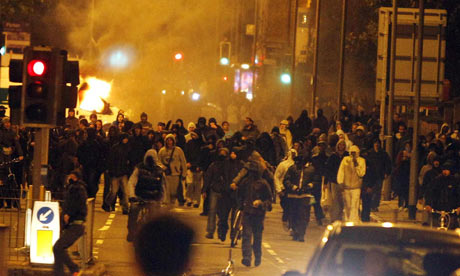
In the UK media, the ‘Arab Spring’ ‘uprisings’ were largely described as
a good thing, while the UK ‘riots’ were condemned. In fact, there was a very well-worn
repertoire which was used to characterize the events in London, Birmingham,
Manchester and so on: converge, submerge, and copy-cat. The riots were said to be about the ‘convergence’ of people who were ‘simply criminals’, their ‘submergence’ in the crowd (which
supposedly leads to being ‘swept up’, ‘carried away’ and hence loss of self-restraint),
and then the supposedly mindless ‘copy-cat’
riots, as ‘other people’ did the same thing elsewhere. The effects of
investor behaviour on financial markets was also seen as bad; however, while the
Occupy movement undoubtedly seen by some commentators as bad, this was not usually
on a par with an illness. Perhaps this was because of their ‘moral’ message;
bad behaviour in the markets was already the target. But maybe it was also
because these events, unlike the riots, were not ‘violent’.
What’s wrong with
‘contagion’?
‘Contagion’ and associated metaphors are therefore not neutral terms
used simply to describe. They are also weapons. In nineteenth century France,
the notion that crowd behaviour is pathological became systematized and
rationalized through the introduction to social science of a medical discourse
(not only ‘contagion’, but also ‘feverishness’ and ‘delirium’) by the psycho-historian
Taine.1
Of all the ways to describe social influence and the rapid spread of
ideas, beliefs, feelings and behaviours, why choose a disease metaphor? Why
choose a term that likens the process to a sickness or illness? The concept
buys you the implication that the spread is bad, or toxic, debilitating or
harmful in some way. But it also implies that the spread is uncritical, simple,
non-cognitive, primitive – that anyone is susceptible to just anything.
Contagion is implied to be a non-rational process, maybe a deeply irrational
one.
Whether the spread of a behaviour, idea or sentiment is good or bad may
be a value judgement. But whether or not just any behaviour spreads to just
anyone is an empirical question.
As Milgram and Toch (1969)2 pointed out in their critique of
Le Bon, if behaviours and sentiments spread through contagion all those simply ‘submerged’ in a crowd,
why aren’t riot police affected by the words of crowd demagogues? Why do the
protestors in the crowd behave one way and the riot police another way? What
are the limits of spread?
The riot in the St Pauls district of Bristol, in 1980, afforded a
systematic test of the idea that just any behaviours do not spread
indiscriminately among just anyone. The riot was the first of the big 1980s
urban riots. The event which was suggested to have set it off was a police raid
on a local café. It was certainly a violent event – there were attacks on the
police and on property; over 20 police vehicles were damaged. However, analysis of the event showed that there were clear limits to the spread of behaviours
that simply do not make sense in terms of ‘contagion’. In particular, there
were limits in terms of action. Essentially, the only people that were attacked
were the police. The property that was damaged comprised banks, the benefits
office, the rent office and the post office, and expensive shops owned by
‘outsiders’. But homes and small locally owned shops were actively protected.
And there was disapproval when someone threw a missile at a bus. In other
words, behaviours that were not consistent with the shared social identity of
those in the crowd – St Pauls residents – did not spread.
Recent research has added to this by showing how the
spread of the 1981 riots – Toxteth, Brixton, Handsworth and others – was not
random. Participants in the different cities did not mindlessly ‘copy-cat’ just
any other person doing any action simply because they heard of it and had seen
it on their televisions. Through a combination of mathematical modeling and
oral history, the research was able to show that the riots spread partly
through shared subcultural networks and partly when people recognize themselves
and their own experiences in the others they saw rioting.3 This
point will be developed below.
Can contagion be
rehabilitated?
For those in the mass media casting about for words to describe the
rapid spread of a protest or direct action movement, whether in Algeria or Florida, ‘contagion’ is as an easy, off-the-shelf cliché. Looking at the origins
of the term historically, the problems are clear. For the early ‘crowd
scientists’, the crowd was an alien other – a source of irrational behaviour and
hence of society’s ills. They sought to combat the crowd, and pathologizing it
was a means of achieving that – for the attribution of irrationality served to
rationalize increased coercion.
In some areas of contemporary academia, though, there has been an
attempt to rehabilitate the concept. An example is network analysis, which have
attempted to redefine contagion as a form of rational social decision-making.
But why try to reclaim this notion with all its baggage? Wouldn’t a more
neutral concept like social influence or spread be less problematic? It might
be possible to redefine ‘contagion’ as rational by stipulation; but the trouble
is that it already has 100 years of history in which it refers to an irrational
and pathological process.
In psychology, ‘contagion’ persists in the concept of ‘emotional
contagion’. This is said to be an often non-conscious transmission of mood
between people. The implication is, again, that this is primitive and hence
non-cognitive; and the origins and indeed pathologizing implications of the concept appear to be ignored by many who use the term.
From a social identity perspective, the problem with the concept of
‘emotional contagion’, and indeed the types of paradigms that have been used to
show evidence for it, is that there is a neglect of the meaning-defining role
of group memberships. Implicit in studies where people ‘catch’ moods and
emotions off others is shared group membership. Of course others’ laughter and
tears is ‘infectious’ – in a shared ‘human’
context. But imagine a context where the people expressing emotion are so
deeply ‘other’, where their world is so different from or irrelevant to yours,
that the source of their emotions and feelings are alien too. Will you catch
them then? We will be running some experiments to show that so-called
‘emotional contagion’ effects will be diminished in ‘alien’ contexts, but
increased in those contexts where shared group membership is salient.
Social identification and
empowerment: An alternative to contagion
An alternative to ‘contagion’ as an explanation for the spread of
behaviours in the ‘Arab Spring’, the UK riots and the ‘Occupy’ movement is in
terms of social identification and
empowerment. In this account, whether in Tunisia, Tottenham and New York, only
those who identified with the participants in these events – those who felt
‘this is us’ – would have felt encouraged or uplifted by them and hence have
felt able to join in.4
In these cases, identifying with the crowd (as ‘us’) in each event also
means recognizing the same enemy. For those involved in the riots, the police
in Tottenham were not distinguished from the police in Hackney, for example:
they were just the police, and equally illegitimate and vulnerable in each
case.
Therefore, where ‘we’ act and ‘they’ are seen to retreat in an event elsewhere, ‘we’ can infer that that
‘the same’ action may be possible here too. Only those who identify are
empowered. There is no need to posit a different kind of theoretical account
for what has happened in the ‘Arab Spring’ and the Occupy movement than in the
case of the UK riots. The actions spread – they became a movement – because the
relevant people took strength from the fact that they, as a physically dispersed
but psychologically unified group, were seen to be able to objectify their
understanding of how the world should be. We have been testing these ideas
directly with some simple experiments. However, all the coverage and
participant accounts produced following each of the movements fits this
analysis.
Notes
1 McClelland, J. S. (1989). The crowd and the mob: From Plato to Canetti.
London: Unwin Hyman.
2
Milgram, S. & Toch, H. (1969). Collective behavior: Crowds and social
movements. In G. Lindzey & E. Aronson (eds.), The Handbook of Social Psychology. Volume 4. (Second edition).
Reading, Mass: Addison Wesley.
3 Ball, R. (2011). Violent urban disturbance in
England in 1981. Unpublished PhD Thesis. University of West of England.
4 The case of the markets is
different, for a number of reasons. First, there is a question over whether the market should be understood as constituting a psychological crowd at all. Second, unlike the three social movements, the markets are not an otherwise
subordinate social group whose action changes their social relations. Therefore, third, if
there is any shared social identification – if people in the financial markets
do use others’ conduct as a guide for their own conduct – this social influence
may well be as bounded (to ‘people like us’) as it is in any other ‘crowd’, but
it can hardly be understood as a process of empowerment.
Reference
Subscribe to:
Posts (Atom)