Wednesday, 1 August 2012

Friday, 20 July 2012
Wednesday, 28 March 2012
The logic of ‘panic buying’
This week, the government (and the mass media) have
been criticized for promoting ‘panic-buying’ of petrol in the context of a possible tanker drivers strike. Here
at Sussex University, we have been looking at the use of the word ‘panic’, and
at the kinds of behaviours that are sometimes labelled in this way. We have also
worked alongside emergency planners and crowd safety management professionals
on this question of communication in possible emergency situations. Based
on this work, there are three simple points to make about the current situation
of supposed ‘panic-buying’.


Run on the Seamen's Savings' Bank during the so-called ‘panic’ of 1857
(courtesy of Wikipedia commons)
1, Don’t say ‘don’t panic’
The first point is that the advice ‘don’t panic’ is worse than
useless. When those in authority say ‘don’t panic’, or even ‘stay calm’,
the rest of us know by this that there is definitely something we should be
anxious about – for why else would they be warning us in this way? And why else
should they be so concerned about our emotional responses if not because they
think there is something that we might ‘panic’ about? In the present case, the
advice that there was no crisis, but that people should fill up their cars just in case, was as good as advice to act exactly as though a crisis was imminent
and therefore to fill up as much as we can.
2, Belief that there is ‘panic’ makes it logical to act individualistically
The advice ‘don’t panic’ is based on the mistrust by the
government of the (potentially irrational) ‘masses’. In turn it sows mistrust.
It does this in two ways. First, the advice communicates that the government is
holding something (scary) back from the public, so creates mistrust between
public and government. Second, reference to ‘panic’ risks creating mistrust
amongst members of the public themselves. When the government and the mass
media tell us that our neighbours are ‘panic-buying’, we imagine those around
us acting individualistically, rushing to hoard goods for themselves. And if
we imagine that everyone else is acting this way, it becomes foolishly
self-sacrificial to do otherwise oneself. Rather, it becomes completely logical
to look after number one. The result is that we trust our neighbours less to
act patiently and in the collective interest.
3, ‘Panic buying’ is not panic
The third point is that the large queues and the rush to stock up
does not really fit the criteria for panic. Journalists reporting from
the scene of petrol queues note with surprise the calm, boredom and stoicism of
the people waiting in line. ‘Panic’ is a clinical condition marked by an
excessive fear and anxiety reaction, the physiological signs of which include
raised heart rate, shortened breath, sweating and so on. This excessive anxiety
prompts reckless, uncontrolled behaviour. People queuing for petrol
in so-called ‘panic buying’ may be acting in their personal interest
rather than the collective interest, but this is cognitively driven rather than an instinctive ‘flight or fight’ response. The queuing and bulk-buying is logical - given people's reasonable beliefs about others’ behaviour and their reasonable mistrust of the authorities. And there is no spread of irrational beliefs or
emotions through these crowds. As I have argued elsewhere, there is no
evidence to support the argument that crowds are susceptible to the uncritical spread of simple emotions through so-called ‘contagion’:‘mass panic’ is a myth.
It is often the mass media, more than the politicians, who mobilize
the ‘panic’ cliché to describe consumer queuing and stock piling. It is perhaps
encouraging to report, therefore, that not all journalists are so lazy. After
an interview we gave on Radio Leicester to discuss our ESRC research project on mass emergency behaviour, the reporters were so convinced by the argument that
they made it a policy not to use the term in future.
However, we don’t think that solutions to the problems produced by mutual
mistrust and individualism lie only or essentially in changing the messages given out
by those in authority. It was notable that, in his nervous back-tracking, David
Cameron referred to ‘resilience’ as just a quality of the state and its
functionaries. We have been exploring the informal resilience of crowds, which expresses itself in solidarity and is a function of shared social identity among crowd members. We are currently running some experiments to show that, when
people think of themselves in terms of their social identities (e.g., ‘me as a
member of my community’) they will be more cooperative, less ready to push in
to queues, and more willing to share dwindling supplies with strangers than
when they think of themselves in terms of their personal identities (e.g., ‘me
as distinct from others in my community’). If the outcomes of the behaviours labelled as 'panic-buying' are dysfunctional for the collective (e.g., more acute shortages for most as the minority hoard goods) it is precisely because people in the crowd are acting reasonably as individuals, rather than as members of a psychologically united crowd; cf. Mintz, 1951.)
References
Drury, J., Cocking, C., & Reicher, S.
(2009). Everyone for themselves? A comparative
study of crowd solidarity amongst emergency survivors.British Journal of Social
Psychology, 48, 487-506. DOI:10.1348/014466608X357893
Drury, J., Cocking, C., & Reicher, S.
(2009). The nature of collective resilience:
Survivor reactions to the 2005 London bombings. International
Journal of Mass Emergencies and Disasters, 27,
66-95.
Mintz, A. (1951). Non-adaptive
group behavior. Journal of Abnormal and Social Psychology, 46, 150-159.
Sunday, 1 January 2012
2011 - The year of contagion?
In 2011, four of the major news events of the year concerned mass social
influence or the spread of
behaviours. The so-called Arab Spring is said to have begun with a
self-immolation in Tunisia. The protests there escalated until President Ben
Ali was forced to step down in mid-January. Egypt’s uprising also began with a
self-immolation and eventually forced President Mubarek out of office as more
people joined in. Uprisings of varying forms also took place in Yemen, Bahrain and eventually
Libya, with unrest reported across the Arab region as a whole.
In July, the plunging financial markets across the world were said to be subject to ‘contagion’, suggesting that ‘fear’ and ‘panic’ were rapidly
spreading among investors.
In August, the term ‘contagion’ was mobilized again – although more often the term used was ‘copy-cat’ – to ‘explain’ the spread of riots from
Tottenham to Hackney, Ealing, Clapham, Birmingham, Liverpool, Salford and other
places.
Then there was the ‘Occupy’ movement. This began in Wall Street, New
York, but soon spread to other cites in the USA as well as to the UK, in
particular to St Paul’s, London.
The terminology used in each of these news stories tell us a lot about
how the events were evaluated. Specifically, the term ‘contagion’ is not simply
descriptive, but serves to construct events as negative and pathological.
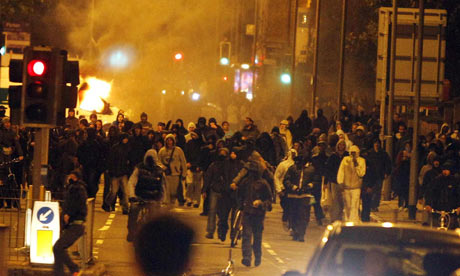
In the UK media, the ‘Arab Spring’ ‘uprisings’ were largely described as
a good thing, while the UK ‘riots’ were condemned. In fact, there was a very well-worn
repertoire which was used to characterize the events in London, Birmingham,
Manchester and so on: converge, submerge, and copy-cat. The riots were said to be about the ‘convergence’ of people who were ‘simply criminals’, their ‘submergence’ in the crowd (which
supposedly leads to being ‘swept up’, ‘carried away’ and hence loss of self-restraint),
and then the supposedly mindless ‘copy-cat’
riots, as ‘other people’ did the same thing elsewhere. The effects of
investor behaviour on financial markets was also seen as bad; however, while the
Occupy movement undoubtedly seen by some commentators as bad, this was not usually
on a par with an illness. Perhaps this was because of their ‘moral’ message;
bad behaviour in the markets was already the target. But maybe it was also
because these events, unlike the riots, were not ‘violent’.
What’s wrong with
‘contagion’?
‘Contagion’ and associated metaphors are therefore not neutral terms
used simply to describe. They are also weapons. In nineteenth century France,
the notion that crowd behaviour is pathological became systematized and
rationalized through the introduction to social science of a medical discourse
(not only ‘contagion’, but also ‘feverishness’ and ‘delirium’) by the psycho-historian
Taine.1
Of all the ways to describe social influence and the rapid spread of
ideas, beliefs, feelings and behaviours, why choose a disease metaphor? Why
choose a term that likens the process to a sickness or illness? The concept
buys you the implication that the spread is bad, or toxic, debilitating or
harmful in some way. But it also implies that the spread is uncritical, simple,
non-cognitive, primitive – that anyone is susceptible to just anything.
Contagion is implied to be a non-rational process, maybe a deeply irrational
one.
Whether the spread of a behaviour, idea or sentiment is good or bad may
be a value judgement. But whether or not just any behaviour spreads to just
anyone is an empirical question.
As Milgram and Toch (1969)2 pointed out in their critique of
Le Bon, if behaviours and sentiments spread through contagion all those simply ‘submerged’ in a crowd,
why aren’t riot police affected by the words of crowd demagogues? Why do the
protestors in the crowd behave one way and the riot police another way? What
are the limits of spread?
The riot in the St Pauls district of Bristol, in 1980, afforded a
systematic test of the idea that just any behaviours do not spread
indiscriminately among just anyone. The riot was the first of the big 1980s
urban riots. The event which was suggested to have set it off was a police raid
on a local café. It was certainly a violent event – there were attacks on the
police and on property; over 20 police vehicles were damaged. However, analysis of the event showed that there were clear limits to the spread of behaviours
that simply do not make sense in terms of ‘contagion’. In particular, there
were limits in terms of action. Essentially, the only people that were attacked
were the police. The property that was damaged comprised banks, the benefits
office, the rent office and the post office, and expensive shops owned by
‘outsiders’. But homes and small locally owned shops were actively protected.
And there was disapproval when someone threw a missile at a bus. In other
words, behaviours that were not consistent with the shared social identity of
those in the crowd – St Pauls residents – did not spread.
Recent research has added to this by showing how the
spread of the 1981 riots – Toxteth, Brixton, Handsworth and others – was not
random. Participants in the different cities did not mindlessly ‘copy-cat’ just
any other person doing any action simply because they heard of it and had seen
it on their televisions. Through a combination of mathematical modeling and
oral history, the research was able to show that the riots spread partly
through shared subcultural networks and partly when people recognize themselves
and their own experiences in the others they saw rioting.3 This
point will be developed below.
Can contagion be
rehabilitated?
For those in the mass media casting about for words to describe the
rapid spread of a protest or direct action movement, whether in Algeria or Florida, ‘contagion’ is as an easy, off-the-shelf cliché. Looking at the origins
of the term historically, the problems are clear. For the early ‘crowd
scientists’, the crowd was an alien other – a source of irrational behaviour and
hence of society’s ills. They sought to combat the crowd, and pathologizing it
was a means of achieving that – for the attribution of irrationality served to
rationalize increased coercion.
In some areas of contemporary academia, though, there has been an
attempt to rehabilitate the concept. An example is network analysis, which have
attempted to redefine contagion as a form of rational social decision-making.
But why try to reclaim this notion with all its baggage? Wouldn’t a more
neutral concept like social influence or spread be less problematic? It might
be possible to redefine ‘contagion’ as rational by stipulation; but the trouble
is that it already has 100 years of history in which it refers to an irrational
and pathological process.
In psychology, ‘contagion’ persists in the concept of ‘emotional
contagion’. This is said to be an often non-conscious transmission of mood
between people. The implication is, again, that this is primitive and hence
non-cognitive; and the origins and indeed pathologizing implications of the concept appear to be ignored by many who use the term.
From a social identity perspective, the problem with the concept of
‘emotional contagion’, and indeed the types of paradigms that have been used to
show evidence for it, is that there is a neglect of the meaning-defining role
of group memberships. Implicit in studies where people ‘catch’ moods and
emotions off others is shared group membership. Of course others’ laughter and
tears is ‘infectious’ – in a shared ‘human’
context. But imagine a context where the people expressing emotion are so
deeply ‘other’, where their world is so different from or irrelevant to yours,
that the source of their emotions and feelings are alien too. Will you catch
them then? We will be running some experiments to show that so-called
‘emotional contagion’ effects will be diminished in ‘alien’ contexts, but
increased in those contexts where shared group membership is salient.
Social identification and
empowerment: An alternative to contagion
An alternative to ‘contagion’ as an explanation for the spread of
behaviours in the ‘Arab Spring’, the UK riots and the ‘Occupy’ movement is in
terms of social identification and
empowerment. In this account, whether in Tunisia, Tottenham and New York, only
those who identified with the participants in these events – those who felt
‘this is us’ – would have felt encouraged or uplifted by them and hence have
felt able to join in.4
In these cases, identifying with the crowd (as ‘us’) in each event also
means recognizing the same enemy. For those involved in the riots, the police
in Tottenham were not distinguished from the police in Hackney, for example:
they were just the police, and equally illegitimate and vulnerable in each
case.
Therefore, where ‘we’ act and ‘they’ are seen to retreat in an event elsewhere, ‘we’ can infer that that
‘the same’ action may be possible here too. Only those who identify are
empowered. There is no need to posit a different kind of theoretical account
for what has happened in the ‘Arab Spring’ and the Occupy movement than in the
case of the UK riots. The actions spread – they became a movement – because the
relevant people took strength from the fact that they, as a physically dispersed
but psychologically unified group, were seen to be able to objectify their
understanding of how the world should be. We have been testing these ideas
directly with some simple experiments. However, all the coverage and
participant accounts produced following each of the movements fits this
analysis.
Notes
1 McClelland, J. S. (1989). The crowd and the mob: From Plato to Canetti.
London: Unwin Hyman.
2
Milgram, S. & Toch, H. (1969). Collective behavior: Crowds and social
movements. In G. Lindzey & E. Aronson (eds.), The Handbook of Social Psychology. Volume 4. (Second edition).
Reading, Mass: Addison Wesley.
3 Ball, R. (2011). Violent urban disturbance in
England in 1981. Unpublished PhD Thesis. University of West of England.
4 The case of the markets is
different, for a number of reasons. First, there is a question over whether the market should be understood as constituting a psychological crowd at all. Second, unlike the three social movements, the markets are not an otherwise
subordinate social group whose action changes their social relations. Therefore, third, if
there is any shared social identification – if people in the financial markets
do use others’ conduct as a guide for their own conduct – this social influence
may well be as bounded (to ‘people like us’) as it is in any other ‘crowd’, but
it can hardly be understood as a process of empowerment.
Reference
Saturday, 12 November 2011
Collective joy and the power of the crowd
A social psychological perspective on
Melanie Manchot’s exhibition ‘Gathering’
Fabrica gallery, Brighton, 8 October - 27 November 2011
Psychology has much to say about crowds, their power, and the strong
emotions that arise from participation in them. This article describes recent
research that addresses the themes on display in Melanie Manchot’s two video
installations, ‘Celebration (Cyprus Street)’ and ‘Walk (Square)’.
Coming together
Celebration (Cyprus Street) is inspired by the tradition of street
parties in London’s East End and was developed over a period of six months with
the residents of Cyprus Street. It was filmed as a
single continuous event, through the technique of tracking through the streets
and the crowds. The participants could be described as diverse; but they are
also together, as one, and it is obvious that they are present on the street to
be with one another and that this is a joyful experience.
The film draws our attention to an
apparent paradox of everyday experience. On the one hand, we seek out and enjoy
crowds. When we celebrate we want to do so with others. We enjoy festivals,
music and sports events when there is an atmosphere that only a big crowd can
provide. But we also find some crowding aversive. We value our ‘personal
space’. Recent research has addressed this apparent paradox. (1) This research
suggests that, in order to understand why being in a crowd can produce such
varied reactions in the same person, we need to conceptualize the self as
multiple and variable, based on our various group memberships. The same degree
of density or proximity is experienced positively or negatively depending upon
which of our group identities is salient.
This argument can be illustrated with a
recent experimental study.(2) Participants were each invited to pull up a chair
to wherever they felt most comfortable, in anticipation of discussion with a
stranger. Prior to this, they had been given a bogus ‘test’ of their
‘communication styles’. They were told either that the stranger was of the same
‘communication style’ as them or a different style. In fact the test and hence
the two ‘groups’ were meaningless. But the participants didn’t know this, and
reliably positioned the chair closer to the expected ‘in-group’ member than the
‘out-group’ member. This result suggests that our enjoyment (or dislike) of
closeness with others, whether interpersonally or in a crowd, is shaped by
whichever of our various identities is salient, rather than by a fixed
‘personal space’ boundary.
The effect shown in this experiment has been replicated with a range of
other measures,(3) including self-reported preferences, negative and positive
emotions, and even expressions of disgust: people report less disgust for
exactly the same body odour when it is categorized as ‘us’ than when it is
‘them’!
Studies of actual crowds provide some real-world validation for this
analysis. In November 2007, a march and rally was organized by UNISON, the
public sector workers’ union, to protest against the then government’s attempts
to privatize the NHS. We surveyed over 100 demonstrators, and found that those
who identified most with the crowd sought a more central (i.e., more crowded)
physical location, and hence closer proximity, to their fellow crowd members.
In addition, immersion in the crowd was associated with collective joy.
Specifically, those who identified most with the crowd reported a more positive
experience, in part due to being in close physical proximity to their fellow
crowd members.(4)
Taken together therefore, the recent research says something about why
we gather together with others (because they identify in the same way that we
do), and why it feels good when we are in a crowd with these others.(5) But
when we come together as a crowd, we often move and act together. What are the psychological effects of such collective
coordination?
Acting together
In Melanie Manchot’s video installation ‘Walk (Square)’, 1000 school children are shown moving in
lines toward a city square, where they merge to become part of a huge
choreographed crowd. They then move together, synchronizing their walking to
form patterns that change, dissolve and re-form.
Walk (Square) is the result of an event constructed by Manchot but
inspired by real situations involving walking as a form of expression:
processions, parades, pilgrimages and protest marches, such as those in the
recent wave of mass demonstrations from the UK to the Middle East.
If the striking choreography
leads the viewer to see the performers as a single entity, it is possible that
the performers themselves may do the same, for this is what recent research in
social psychology has found. In the NHS demonstration study described above, we
found that participants’ sense of being psychologically part of the crowd – their social identity
– increased through participation in the event. Collective joy also increased
over the course of the event, and was partly due to this shared social
identity.
Our explanation for these results was that physical co-action in a group
or crowd can dissolve the psychological boundary between individual and
collective, while intensifying our positive emotional responses. But a field
study like this cannot rule out the possibility that some other factor was
responsible (such as passing of time, or communication, or changing relations
with outside groups).
A follow-up study was carried out in the psychology laboratory, which
enabled us to control all the conditions and so identify any causal relations,
rather than simply infer them as in the demonstration study.(6) Participants
arranged at close physical proximity in small groups were asked to learn
clapping patterns of the type heard in football crowds. They performed the
patterns in the group, either in synchrony or individually. As predicted, only
participants who synchronized their movement came to see themselves as part of
their group and experienced increased positive emotion.
These studies therefore show
that moving together as one in time can serve to construct a collective
identity. This is why rallies and marches are important in building social
movements. It is no coincidence that Melanie Manchot’s two works are inspired not only by mass pilgrimages, processions, and parades, but
also by recent mass demonstrations across both the Arab world and the UK.
A marching crowd is not only
expressive, and therefore rich in meanings and symbols, but is also purposive.
That purpose may be social change. Of course, most crowds do not aim to bring about social change.
Many crowds in fact only exist to reproduce or validate the status quo – for
example through religious ritual or national ceremony. But social change very
often involves crowds.(7) Even crowd events that are supposed to have a
cathartic function may also include a rebellious undertone, threatening to the
status quo. Early carnivals had this dual quality;(8) and riots are often
described as having a ‘carnival atmosphere’, by both participants and those who
observe them.(9)
Crowds and power therefore have a long association. Recent research has
examined the psychology of power-change – empowerment
– in people’s experience of crowd events. Studies of riots, anti-capitalist
demonstrations, anti-roads direct actions, Reclaim the Streets parties,
anti-war marches, as well as numerous experimental simulations, have each shown
the same pattern. We feel more able to take collective actions that we define
as legitimate, yet which may not be permitted by others outside the crowd (such
as the authorities and police), when we perceive that others in the crowd support us in our aims and action.(10)
Comparative studies of protest movements add that a sense of collective agency can be both cause and consequence
of such collective action.(11) In order to act, we need to believe we are capable of such action. But, through our
action and its impact on the world, we authenticate and confirm our own
collective agency; the material results of our collective actions stand as
evidence of the power of our collective identities.
Finally, research on activists’ experiences shows that collective
actions that shift or challenge existing power relations feel joyful, exhilarating and even euphoric.
(12) They feel good; and they may even be good for us, since the sense of
agency and social support associated with collective action are established
predictors of wellbeing.(13)
Melanie Manchot’s two works ‘Celebration (Cyprus Street)’ and ‘Walk (Square)’ are about the relationship between
individual and crowd, about our collective identities, and about how we behave in public
space. A central message is that, through its action, the crowd can both
express and construct our sense of self. Recent research in
social psychology suggests that the power of the crowd – the collective
support, collective agency and collective joy it affords – comes not from a loss of self, but from the augmentation of the self. To paraphrase
John Turner, a founder of the social identity approach in group psychology, the
psychological crowd ‘is precisely the
adaptive mechanism that frees human beings from the restrictions of, and allows
them to be more than just, individual persons’ (Turner, 1987, p. 67).(14)
John Drury and David Novelli
This article was
commissioned by Fabrica and part funded by the European Union Two Seas
Programme. It extends work that the gallery has carried out since 2009 linking artists’
perspectives with current scientific research at leading Universities in the
UK.
Dr John Drury is senior lecturer in social psychology
at the University of Sussex. His research interests include crowd empowerment,
solidarity in mass emergencies, and positive experiences of ‘crowding’. His
research includes studies of anti-poll tax riots and anti-roads direct action
and survivor responses to the London bombings. He has just edited, with Dr
Clifford Stott, a special issue of the journal Contemporary Social Science on the topic of crowds. He is currently
supervising research projects on the Hajj to Mecca, collective action and
wellbeing, and crowd communication by the emergency services.
Dr David Novelli is a social psychologist at the University
of Sussex, specialising in crowds. His research focuses on how social
identities and group memberships influence the ways in which we experience
being in crowds, and how acting together in crowds can affect positive emotions
and feelings of solidarity. This year David was awarded the annual prize for
the country’s most outstanding doctoral thesis by the British Psychological
Society. He is currently looking at how our (positive and negative) experiences
at large-scale music events can be shaped by assumptions about crowds held by
those who organize and manage such events.
References
1.
Novelli,
D. (2010). The social psychology of spatiality and crowding. Unpublished DPhil
thesis. University of Sussex. Available online at http://sro.sussex.ac.uk/6275/1/Novelli,_David_Lee.pdf
2.
Novelli,
D., Drury, J., & Reicher, S. (2010). Come together: Two studies concerning
the impact of group relations on ‘personal space’. British Journal of Social Psychology, 49, 223–236.
3.
Novelli, D. (2010) op.
cit.
4.
Novelli,
D., Drury, J., & Reicher, S. (2011). The relationship between psychological
and physical group processes and their impact on the experience of crowding:
Evidence from a field study. Unpublished manuscript. University of Sussex.
5.
Novelli,
D. (2010) op. cit.
6.
Novelli, D., Drury, J., & Reicher, S. (2011). Synchronized movement as a cause of social identity and positive emotion. Unpublished
manuscript. University of Sussex.
7.
Ackerman,
P., & Kruegler, C. (1994). Strategic
nonviolent conflict: The dynamics of people power in the twentieth century.
Westport, CT: Praeger.
8.
Davis,
N. Z. (1971). The reasons of misrule: Youth groups and charivaris in
sixteenth-century France. Past and
Present, 50, 41-75.
9.
Reicher,
S. & Potter, J. (1985). Psychological theory as intergroup perspective: A
comparative analysis of ‘scientific’ and ‘lay’ accounts of crowd events. Human Relations, 38, 167-189.
10.
Drury, J., & Reicher, S. (2009). Collective psychological
empowerment as a model of social change: Researching crowds and power. Journal of Social Issues, 65, 707-725.
11. Drury, J., &
Reicher, S. (2005). Explaining enduring empowerment: A comparative study of
collective action and psychological outcomes. European Journal of Social Psychology, 35, 35-58
12. Drury, J.,
Cocking, C., Beale, J., Hanson, C., & Rapley, F. (2005). The phenomenology
of empowerment in collective action. British
Journal of Social Psychology, 44,
309-328
- Haslam, S. A., & Reicher, S. D. (2006). Stressing the group: Social identity and the unfolding dynamics of responses to stress. Journal of Applied Psychology, 91, 1037-1052.
- Turner, J. (1987). A self-categorisation theory. In Turner, J. C., Hogg, M. A., Oakes, P. J., Reicher, S. D. & Wetherell, M. S., Rediscovering the social group: A self-categorization theory (pp. 42-67). Oxford: Blackwell.
Background
Melanie Manchot's 2010 film Celebration (Cyprus Street) is a portrait of an East End
neighbourhood, for which Manchot worked closely with local residents to create
a street party, which she filmed. Her more recent work Walk (Square) invites young participants
to walk together and undertake basic choreographed movements. Celebration
(Cyprus Street) was commissioned by Film and Video Umbrella, and Walk (Square)
by Deichtorhallen Museum in Hamburg; both were exhibited at Fabrica gallery in
Brighton, in October / November 2011. The exhibition ran at the same time as
White Night, an event that invited local residents to take part in cultural
activity throughout the night and in so doing created a new kind of social space
which connected the city in a new way.
Manchot described the focus of these works for photography
publication Vignette in October 2011: “Both
Celebration (Cyprus Street) and Walk (Square) investigate a position between
individual and collective experience, and aim to do so through group
portraiture. In these works I set up an event with participants who are,
on the whole, strangers to me and to each other, and who come together through
the processes of the work. The notion of ‘event’ is central to these
works as it is the event, the proposition of a performative situation that the
participants engage with – and that they then fill with their action.
Both works consciously chart a space – and a tension – between choreography and documentation, between construction and chaos. And in many ways this applies to my practice in general, this interest in setting up situations, constructing a scenario, which then develops its very own dynamic, where the people then enact their motivations.
Celebration (Cyprus Street) and Walk (Square) are both based on real events, ‘real life’ so to speak: in one case on historic street parties and the social function they embodied and the other on the recent surge of demonstrations, marches, protests both in the UK and around the world. But rather than being political as such, in the case of both works it is the making of art, of a moving image project, that brings people onto the streets. And public space, the streets and squares we share as social space are another theme that runs through these works as well as through much of my practice”
Both works consciously chart a space – and a tension – between choreography and documentation, between construction and chaos. And in many ways this applies to my practice in general, this interest in setting up situations, constructing a scenario, which then develops its very own dynamic, where the people then enact their motivations.
Celebration (Cyprus Street) and Walk (Square) are both based on real events, ‘real life’ so to speak: in one case on historic street parties and the social function they embodied and the other on the recent surge of demonstrations, marches, protests both in the UK and around the world. But rather than being political as such, in the case of both works it is the making of art, of a moving image project, that brings people onto the streets. And public space, the streets and squares we share as social space are another theme that runs through these works as well as through much of my practice”
Acknowledgements
Celebration
(Cyprus Street) was commissioned by Film and Video Umbrella and supported by
Arts Council England. Funded by Film London and the UK Film Council Digital Archive
Film Fund and supported by the National Lottery.
Walk (Square) was commissioned by Deichtorhallen and Kulturforum 21, Hamburg for the exhibition Wunder. Walk (Square) received additional funding from Film and Video Umbrella. The activities connected to the exhibition are also supported by Brighton & Hove Council, the IRIS Contemporary Art Network and Interreg, a European Union funding programme aimed at dialogue between neighbouring European countries.
Walk (Square) was commissioned by Deichtorhallen and Kulturforum 21, Hamburg for the exhibition Wunder. Walk (Square) received additional funding from Film and Video Umbrella. The activities connected to the exhibition are also supported by Brighton & Hove Council, the IRIS Contemporary Art Network and Interreg, a European Union funding programme aimed at dialogue between neighbouring European countries.
Gathering – 8 October – 27 November 2011 – Fabrica, Brighton UK
Saturday, 10 September 2011
What do the events of 9-11 tell us?
From the beginning, the mass evacuations of September 11th 2001 were thought to tell us something important about the nature of collective responses to emergencies and disasters. In the months and years following the events, social scientists carried out detailed research investigations of behaviour during the evacuations. Some of their key findings were as follows:
- The building evacuations were highly successful; 99 per cent of occupants below the sites where the planes struck survived. The success was due in large part to efficient spontaneous mass coordination among the people who moved down the stairs of the World Trade Centre towers.
- Cooperation and helping behaviour was common among the building evacuees
- Panic was not a collective response; Ed Galea's team found that panic ‘was only noted in 1/124 (0.8%) cases’; gathering information was a more common response to the emergency.
- Over one million people evacuated themselves from the area of New York affected by the disaster, and thousands of members of the public converged on the city in order to offer help to the survivors. A strong sense of community arose among those involved in the evacuation and in the relief effort.
What do these kind of findings mean for our understanding of the nature of collective responses to emergencies and disasters?
For researchers, this is further evidence against already discredited theories such as ‘mass panic’. Theories of ‘mass panic’ suggest that exaggerated fear responses to danger spread easily through a crowd in a process of ‘contagion’, leading to rash, uncoordinated and ultimately dysfunctional behavioural outcomes, such as fighting for and blocking exits. Against this, current thinking on group processes suggests that group membership is not a source of pathology but a source of strength. Psychological group membership provides expectations of unity, offers of support and hence the organization and collective agency people need to respond effectively to adversity. The evidence from the 9-11 evacuation is in line with this account of group processes.
However, the evidence of collective resilience during 9-11 has also been interpreted by some as telling us something about the national identity of the USA. In this account, the resilient behaviour of the evacuees stands for or represents the character of the rest of those included in the national category.
Are there cross-cultural differences in mass emergency behaviour?
On the one hand, and at least in one sense, it is surely right to say that the evidence from the 9-11 evacuations tells us something about American responses to adversity.
One (mis)reading of cross-cultural psychology gives rise to the question of whether people from individualist national cultures (like the USA) will display less solidarity in mass emergencies than those from ‘collectivist’ cultures (such as Japan). It is a question that I am often asked when I give research presentations. One answer to the question is that, across national cultures as diverse as Japan, the USA, Britain and Germany, the same pattern of solidarity (rather than mass panic) has been documented in response to mass emergencies and disasters. The evidence of mutual coordination and co-operation shown by ‘ordinary Americans’ in the 9-11 mass evacuations therefore undermines notions that this country’s individualist culture precludes the emergence of ties of solidarity and collective strength.
On the other hand, when the collective resilience witnessed in the 9-11 evacuations is taken by politicians and propagandists to demonstrate something special or exceptional about the psychology of the American national category, we can see problems. Specifically, there are two problems with this kind of claim.
Problem 1: Every national category is claimed by its leaders to be ‘special’ in times of war
The first problem is that representatives of every nation state try to claim that their citizens’ resilient response to adversity is special or even unique. It is no coincidence that highlighting public resilience and characterizing the resilient group as standing for the whole national category is particularly prominent in times of war.
In the second world war, the British state highlighted the ‘Blitz spirit’ of Londoners, who faced nightly bombing raids, as a way of raising national morale. The terminology and the image were less a neutral description of events than an attempt to mobilize and create national unity around the war. Following the London bombings of July 2005, politicians and commentators similarly evoked the ‘bulldog spirit’ of Londoners, attributing the calm orderly response of survivors to their special characteristics, which would again serve the nation well in a time of war 'against terror'.
As simple descriptions, these claims to exceptionalism are undermined by the same kind of review evidence that tells against the cross-cultural hypothesis. However, they are not simply descriptions. They are attempts to rally people to wars, and to bring about the resolve and unity of which they speak; they can also operate as exhortations to endure privations in the interest of war on behalf of the national category.
This takes us to the second problem.
Problem 2: Are we really ‘all in it together’?
The second problem with explaining events such as the 9-11 evacuations in terms of the qualities of the national category is that it glosses over possible differences among those included in 'the nation' in terms of interests, experiences and behaviours. Disaster psychologists tell us that both suffering and assistance are often distributed inequitably — reflecting structured inequality in resources (for example by class).
Disaster sociologists and critical journalists add that ‘elites’ and ‘masses’ perceive and respond to emergencies and disasters differently. This can mean that definitions of collective threat may not be universally shared, and therefore that solidarity may be bounded. Specifically, the representatives of the ‘elites’ may regard the response of the mass as more problematic than the emergency itself, and act against the mass on this basis. This is perhaps most starkly illustrated in examples such as Hurricane Katrina in 2005. In that ‘national emergency’, grassroots solidarity arose particularly in the black working class. However the authorities neglected and imperilled their safety, demonized and pathologized them in propaganda, and colluded in their racist murder.
Accounts of the evacuation of 9-11, by contrast, paint a far less fragmented picture, and indeed illustrate how different sections of society displayed camaraderie during the evacuation.
However, the narrative of businesses and workers alike coming together in shared humanity is somewhat problematized by the fact that, when the first plane struck on 9-11, the immediate response of the Port Agency, who are in charge of the World Trade Centre buildings, was to urge employees to return to their desks. Luckily, most people ignored this advice!
And in the aftermath, a number of underlying social conflicts became explicit. One of the fundamental tensions within the national category was between the masses and the professionals acting on behalf of the ‘elite’. Grassroots and unofficial groups and networks had established themselves and were managing very well to organize food, housing, communications and security for evacuees. But official organizations moved in and sought to shut them down. The ‘festival of mutual aid’ was superseded by an 'elite panic’.
It was not the ‘elite’ and their professionals who effected the mass evacuations; the masses achieved it themselves. The 911 emergency call system was ineffective; the police and fire service did not coordinate properly; people organized evacuation and relief despite, not because of, the normal hierarchical rules and relations. The collective response to the emergency was effective precisely because it was not centrally directed; but professionalization of, and exclusive control over, humanitarian relief was nevertheless imposed. The national policy response went further: national (‘homeland’) security, emphasizing suspicion of one’s neighbours and the need for further centralized control. Through its actions, the ‘elite’ undermined sources of collective resilience and hence produced the very vulnerability - including paralysing fear, lack of freedom and reduced agency - that it was premised upon.
What do the events of 9-11 tell us?
The 9-11 evacuations tell us at least three things.
First these events illustrate very vividly the human potential for solidarity within groups in conditions of adversity.
Second, collective psychosocial resources – and especially the informal and context-dependent psychological groups we belong to – may well be more important than expert and professional response in times of emergency. For one thing, in a large scale emergency, the emergency professionals will simply not be in place in sufficient numbers to be effective.
Third, while the ‘elite’ therefore relies on the masses in emergency response, it also fears them. The otherwise useful concept of ‘elite panic’ could be read as implying that this fear is simply irrational. Elite responses may well be ill-judged, but they may be grounded in fear of real potentials. Following Charles Fritz, Rebecca Solnit argues that disasters are microcosms of mutual aid that may provide insightful glimpses of social possibility. It may be that elites recognize these subversive qualities too, and hence the potential danger to their own privileged position.
Reference
Drury, J. (2012). Collective resilience in mass emergencies and disasters: A social identity model. In J. Jetten, C. Haslam, & S. A. Haslam (Eds.), The social cure: Identity, health, and well-being (pp. 195-215). Hove, UK: Psychology Press.
Subscribe to:
Posts (Atom)